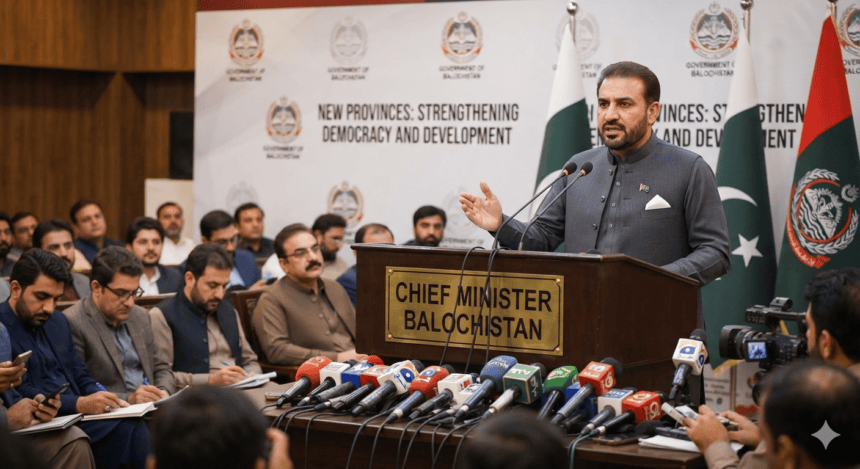
Chief Minister Balochistan Sarfraz Bugti has thrown his weight behind the creation of new provinces, arguing that smaller administrative units are essential for effective governance. His comments, delivered during a recent policy session in Quetta, signal a potential shift in the provincial government’s stance on a long-standing and contentious debate in Pakistani politics.
Bugti contends that the current administrative structure is too centralized to address the localized needs of diverse populations. By breaking down larger provinces into smaller, manageable units, he argues the state can deliver services—from healthcare to infrastructure—with greater speed and accountability.
“The status quo isn’t working for the grassroots level,” Bugti told reporters, suggesting that the primary friction point in national development remains the distance between the citizen and the decision-maker.
Critics, however, remain skeptical. Political opponents and certain nationalist factions view the push for new provinces as a tactical distraction from the province’s immediate crises, including the ongoing security situation and the management of its natural resources. Historically, the debate over redrawing provincial maps has been fraught with fears of ethnic polarization and the potential dilution of regional political influence.
While Bugti did not offer a specific roadmap for how these new provinces would be carved out, his endorsement adds significant weight to a conversation that usually stalls at the federal level. The constitutional threshold for creating new provinces is high, requiring a two-thirds majority in parliament—a hurdle that has stymied previous attempts by various political parties.
For now, the Chief Minister’s remarks serve as a trial balloon. Whether this leads to a formal legislative proposal or remains a rhetorical shift depends on how quickly he can build a consensus among coalition partners who remain wary of upsetting the existing provincial power structure.
As the debate gains momentum, the central government in Islamabad has yet to issue a definitive response, leaving the political class to speculate on whether this signals a genuine policy pivot or merely a strategic play to decentralize the pressure currently mounting on the provincial capital.