Artificial intelligence has moved from research labs into the daily operations of global industry, forcing a reckoning with its capability to reshape society. While the technology promises to unlock unprecedented productivity, it simultaneously introduces systemic risks that regulators and developers are struggling to contain.
The Gains
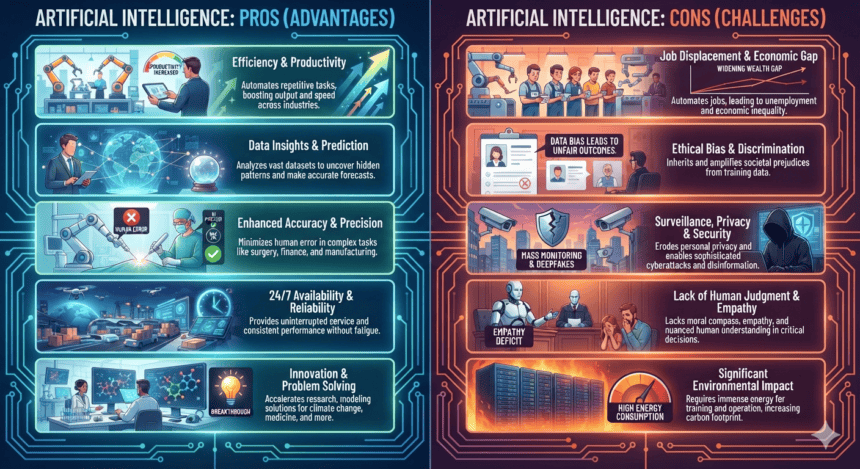
Efficiency leads the list. AI systems process massive datasets in seconds, performing tasks like medical diagnostics or financial auditing that once took human teams weeks. This speed offers a clear economic advantage for businesses operating in high-volume environments.
Innovation follows closely. By identifying patterns invisible to the human eye, AI is accelerating drug discovery and materials science. Researchers are using these models to simulate molecular interactions, potentially shaving years off the development of life-saving treatments.
Automation handles the mundane. AI excels at repetitive, data-heavy tasks, freeing workers to focus on creative or complex problem-solving. This shift could redefine labor markets, pushing employees toward roles that require emotional intelligence and nuanced judgment.
Accessibility is expanding. AI-driven translation tools and personalized education platforms are breaking down language and learning barriers. Students in remote areas can now access high-level tutoring, while real-time translation makes global commerce more inclusive.
Scalability remains a primary driver. Once an AI model is trained, it can operate at a global scale without fatigue. This allows companies to provide 24/7 support and services, creating a level of operational consistency that is impossible to maintain with human staffing alone.
The Risks
Job displacement is the most immediate concern. As algorithms take over routine cognitive tasks, millions of roles—from data entry to entry-level legal research—face obsolescence. The transition risks leaving a significant portion of the workforce behind without clear paths for reskilling.
Bias remains embedded in the code. Because models are trained on historical data, they often inherit and amplify societal prejudices. This leads to discriminatory outcomes in hiring, lending, and law enforcement, where the “black box” nature of AI makes it difficult to trace or challenge unfair decisions.
Security vulnerabilities are rising. The same technology that aids in discovery can be weaponized. Sophisticated deepfakes, automated phishing campaigns, and AI-powered cyberattacks have already begun to erode public trust in digital information and infrastructure.
Privacy is eroding. To function, these systems require vast amounts of personal data. The constant collection and analysis of user behavior create a surveillance landscape where anonymity becomes nearly impossible to maintain, raising questions about who owns—and who controls—individual digital identities.
Dependency creates fragility. As industries integrate AI into core infrastructure, they risk losing the ability to function without it. A system-wide outage or a catastrophic error in an autonomous model could paralyze critical sectors, from power grids to logistics, before human intervention can stop the chain reaction.
The technology is not a neutral tool. Its impact depends entirely on the guardrails placed around its development and the transparency required of the companies building it. For now, the world is betting that the benefits will eventually outweigh the disruption. Whether that gamble pays off depends on how quickly the current, largely unregulated, landscape is brought under control.