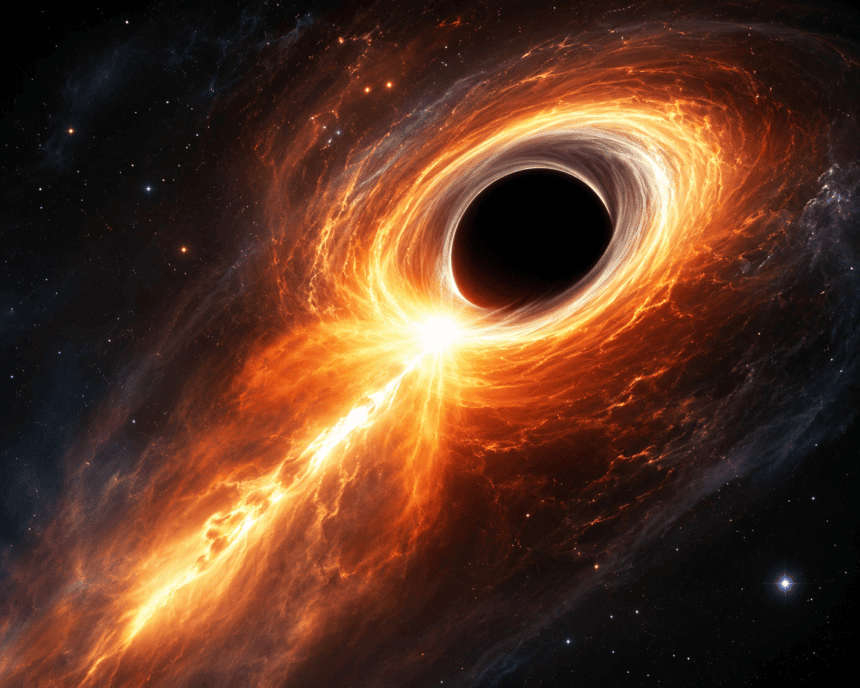
A supermassive black hole located 500 million light-years away has erupted for the third time in less than a decade, offering researchers a rare, front-row seat to one of the universe’s most violent phenomena.
The black hole, situated at the center of the galaxy known as ASASSN-14ko, has displayed a rhythmic pattern that defies standard astrophysical models. While most black holes consume material at a relatively steady rate, this one flares with predictable, clockwork precision. Every 114 days, the black hole tears through a portion of a nearby star, triggering a massive release of energy that ripples across the cosmos.
Data from NASA’s Neil Gehrels Swift Observatory confirmed the latest event, catching the system in the midst of its periodic outburst.
For scientists, the “why” remains the primary challenge. Current theories suggest the black hole is likely locked in a gravitational dance with a smaller, orbiting star. Each time the star swings close enough to the black hole’s event horizon, tidal forces strip away a significant layer of the star’s outer atmosphere. This material spirals into the black hole, heating up and emitting a burst of light that telescopes can detect from Earth.
“It’s an incredibly rare find,” said one researcher close to the study. “Seeing this happen once is a stroke of luck; seeing it happen three times with this level of consistency forces us to rethink how we categorize these events.”
This cycle—known as a periodic nuclear transient—provides a unique laboratory for studying accretion. By tracking the exact timing of these eruptions, teams are mapping the gravitational environment near the black hole with unprecedented accuracy.
The consistency of the 114-day cycle is the real outlier here. Most black hole-star interactions are either one-off events that destroy the star entirely or chaotic, unpredictable feedings. ASASSN-14ko is doing neither. It is effectively “grazing” on its companion, taking a bite every few months without causing a total cataclysm.
As the observatory continues to monitor the galaxy, the focus has shifted to predicting the next flare. If the pattern holds, the black hole will reach its next peak in late spring, providing another chance to test whether this cosmic rhythm is a stable feature or a temporary phase in the galaxy’s evolution.
For now, the data confirms one thing: the universe is far more rhythmic than our current models suggest.