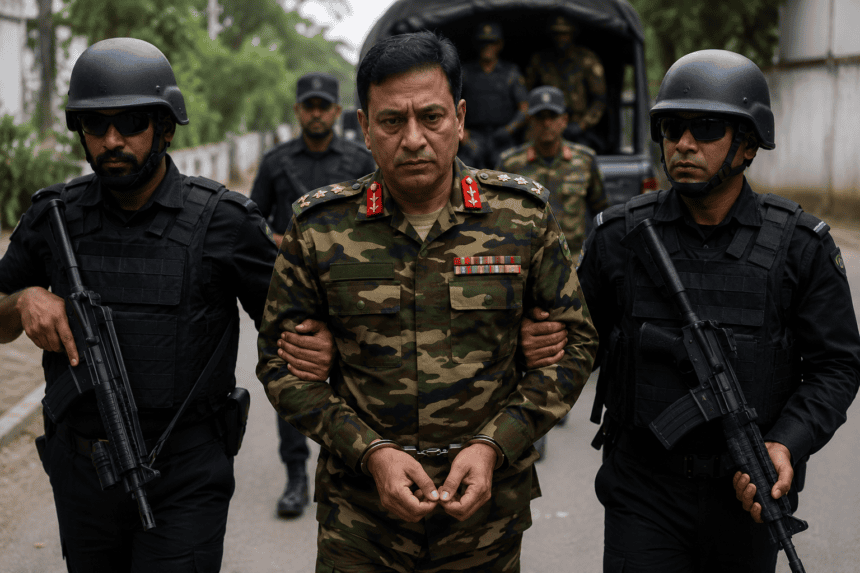
DHAKA — Military police have detained Major General (retd) Ziaul Ahsan, a former commander of the National Security Intelligence (NSI), as the country’s interim government moves to address allegations of extrajudicial killings and enforced disappearances.
Authorities took Ahsan into custody late Thursday night while he was attempting to leave the country. His arrest follows a wave of legal complaints filed against former government officials in the wake of Prime Minister Sheikh Hasina’s resignation and flight to India.
The case centers on the 2013 Shapla Chattar operation, where security forces dispersed thousands of protesters from the Hefazat-e-Islam group in central Dhaka. While the government at the time claimed only a few casualties, human rights organizations and opposition groups have long maintained that the death toll was significantly higher and the operation was a calculated, lethal crackdown.
Ahsan, a career intelligence officer, was a key figure within the security establishment for over a decade. His presence in the upper echelons of the NSI and the Rapid Action Battalion (RAB) made him a central, if shadowy, architect of the previous administration’s internal security strategy. For many, his detention signifies a shift in the legal landscape of post-Hasina Bangladesh.
“We are documenting every instance of abuse, and those who held the levers of power will have to answer,” said a legal advisor to the interim administration. The advisor, speaking on condition of anonymity due to the sensitivity of the investigations, noted that the state is currently reviewing thousands of reports involving police and military personnel accused of human rights violations.
Critics of the previous government argue that the 2013 crackdown set a precedent for the state’s reliance on force to suppress dissent. Families of the victims have waited over a decade for an investigation, only to be met with official silence until the current political upheaval.
The detention is not an isolated event. It follows the filing of several murder cases against former ministers, police chiefs, and top bureaucrats. The interim government, led by Nobel laureate Muhammad Yunus, faces the monumental task of restoring institutional credibility while navigating a fragile political transition.
Whether these arrests lead to successful prosecutions or remain symbolic gestures remains the primary question for a public exhausted by years of political polarization. For now, the detention of a high-ranking intelligence officer serves as a blunt message to the country’s security apparatus: the era of perceived impunity has ended.