WALES, September 12, 2026: Conservationists are working to save one of Britain’s rarest freshwater animals — the glutinous snail, a tiny, delicate mollusc now known in the wild from just one lake in the United Kingdom.
The snail, scientifically known as Myxas glutinosa, survives at Llyn Tegid, also called Bala Lake, in north Wales. Once widespread across Britain, it has disappeared from England and is now facing serious threats from pollution, habitat changes and fluctuations in water levels. <Cite refs={[“turn1search2″,”turn1search1″,”turn1search3”]} />
A Small Snail With a Unique Appearance
The glutinous snail is no bigger than a fingertip. Its thin, translucent shell is covered by a jelly-like mantle, giving the animal a soft, gooey appearance.
The mantle also makes the snail unusually delicate and difficult to handle. Conservationists describe it as one of Europe’s most endangered freshwater molluscs.
Unlike many other freshwater snails, the glutinous snail has very specific habitat requirements. It needs exceptionally clean water and mainly feeds on algae growing on underwater surfaces. <Cite refs={[“turn1search1″,”turn1search3”]} />
Llyn Tegid: Its Last Known UK Refuge
Llyn Tegid is Wales’ largest natural lake and the only known wild location of the glutinous snail in Britain.
The species was rediscovered in the lake in 1998 after it had not been recorded there for several decades. Monitoring has shown that the snails live mainly in the shallow margins of the lake, where changes in water levels can quickly affect their access to food and shelter. <Cite refs={[“turn1search5″,”turn1search14”]} />
The snail’s dependence on shallow water makes it particularly vulnerable. If water levels fall sharply, the algae it needs may disappear. If the snail is forced into deeper water, it may no longer be able to feed effectively.
Conservationist’s Home Becomes a Breeding Centre
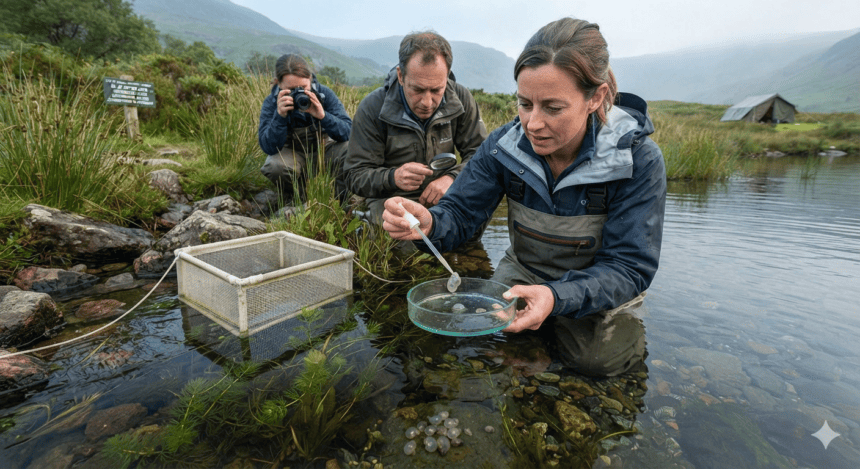
Ecologist Ian Hughes has spent years trying to understand and protect the species. Working from his home in Ceredigion, he has created tanks and breeding facilities to establish a captive population.
His efforts have already produced an important breakthrough: eggs were observed in one of the tanks after several months. The discovery helped scientists learn more about the snail’s reproduction, which had previously been poorly understood. <Cite refs={[“turn1search2″,”turn1search8”]} />
Hughes has also designed small concrete refuges for the snails in Llyn Tegid. These shelters are intended to provide protection close to the lake’s surface, particularly when water levels fall or conditions become unsuitable.
Zoos Create “Ark Populations”
Several British zoos are now helping to establish backup populations, sometimes described as “ark populations.”
The aim is to ensure that the species does not disappear completely if the remaining wild population is affected by pollution, disease or an environmental disaster.
The British and Irish Association of Zoos and Aquariums has coordinated conservation work involving institutions including:
- Dudley Zoo and Castle
- Chester Zoo
- Longleat Safari Park
- Wingham Wildlife Park
- Askham Bryan Conservation and Wildlife Park
These facilities are working to maintain breeding groups, improve knowledge of the snail’s needs and explore the possibility of returning the species to suitable habitats in England. <Cite refs={[“turn1search0″,”turn1search6”]} />
Pollution and Habitat Loss
The decline of the glutinous snail is closely linked to the deterioration of freshwater habitats.
Agricultural runoff, nutrient pollution and changes to water quality can damage the clean-water conditions the species needs. Habitat loss and invasive species may also reduce the availability of suitable areas for feeding and breeding.
Because the snail is highly sensitive to pollution, its presence can act as an indicator of the health of a lake or river. Protecting it therefore means protecting the wider freshwater ecosystem as well. <Cite refs={[“turn1search1″,”turn1search3”]} />
Why the Species Matters
Although the glutinous snail is small, conservationists say its survival is important for several reasons.
First, it represents a unique part of Britain’s natural heritage. Second, its sensitivity to water pollution makes it a valuable indicator of freshwater quality. Finally, saving the snail could help protect other aquatic species that depend on the same clean-water habitats.
Conservation groups hope that captive breeding, habitat protection and continued monitoring will eventually allow the snail to return to additional sites.
For now, however, its future remains closely tied to the condition of one Welsh lake — and to the efforts of scientists, zoos and volunteers determined to prevent Britain’s tiny, gooey snail from disappearing.