Most parents drop their children at the school gate assuming they’re leaving them in a sanctuary. They aren’t. From crumbling ceilings in rural districts to unchecked harassment in high-end urban private schools, the “safe space” has become a myth for thousands of students. The numbers tell a grim story. In Sindh alone, over 6,000 school buildings are officially classified as “dangerous.
” These aren’t just administrative labels; they represent classrooms where children sit under cracked concrete, waiting for the next monsoon to test the roof’s integrity. Government promises to renovate usually stall at the funding stage, leaving teachers to conduct classes in open courtyards or under trees to avoid a collapse. Physical safety is only half the battle.
The surge in reported cases of bullying and sexual harassment reveals a deeper systemic rot. High-profile incidents over the past year in Lahore and Islamabad showed that even elite schools charging exorbitant fees lack transparent grievance mechanisms.
Victims are often silenced to “protect the institution’s reputation,” while perpetrators face little more than a temporary suspension. Schools are supposed to have vetted staff. They don’t always. Background checks for non-teaching personnel janitors, bus drivers, and security guards are frequently skipped to save costs or speed up hiring. It’s a gamble parents don’t realize they’re taking every morning.
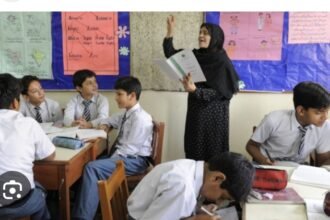
CCTV cameras, where they exist, are often broken or unmonitored, serving as a psychological deterrent rather than a functional security tool. Child psychologists warn that this environment has a direct cost on learning. A child worried about a bully in the hallway or a falling roof in the classroom isn’t absorbing algebra.
They’re in survival mode. The “constant state of low-level fear,” as one Islamabad-based counselor put it, leads to long-term trauma that follows students far beyond graduation.
The issue isn’t a lack of policy; it’s a lack of consequences. Building codes exist. Harassment laws are on the books. But enforcement is selective. Private school regulators often lack the teeth to penalize powerful owners, and public sector officials are rarely held accountable for the state of government property.
Talk is cheap, and policy papers are gathering dust. Until schools are held legally and financially accountable for every bruise and every trauma that happens on their watch, “safety” remains a marketing slogan rather than a reality. The school gate shouldn’t be a boundary where a parent’s peace of mind ends.