By using this site, you agree to the Privacy Policy and Terms of Use.
Accept
Media HydeMedia Hyde
  • Home
  • Politics
  • Education
  • Entertainment
  • Sports
  • Blogs
  • Business & Commerce
  • Others
    • Religious
    • Metropolitan
    • Climate and Weather
Font ResizerAa
Media HydeMedia Hyde
Font ResizerAa
  • Home
  • Politics
  • Education
  • Entertainment
  • Sports
  • Blogs
  • Business & Commerce
  • Others
    • Religious
    • Metropolitan
    • Climate and Weather
Follow US
© 2026 Media Hyde Network. All Rights Reserved.
Health

Bio-Engineered Patch Eliminates 97% of Cancer Cells in Early Trials

Last updated: May 3, 2026 3:58 pm
Misbah Jogyat
Share
Bio-Engineered Patch Eliminates 97% of Cancer Cells in Early Trials
SHARE

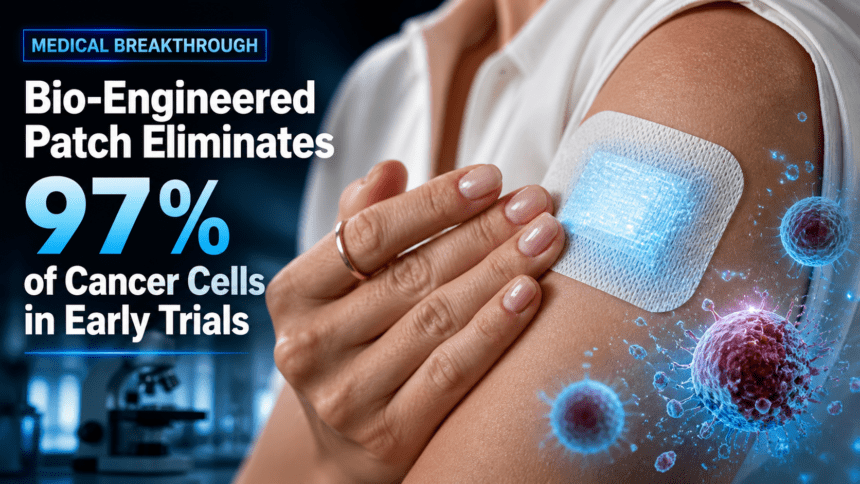
A team of researchers has developed a wearable patch capable of destroying 97% of cancer cells in localized tumors, potentially offering a non-invasive alternative to surgery. The device, which functions by delivering targeted immunotherapy directly through the skin, successfully eliminated aggressive tumor models in lab testing without the side effects typically associated with systemic chemotherapy.

The patch relies on a microneedle array that creates microscopic pathways into the skin. Once applied, it releases a cocktail of specialized antibodies and immune-boosting agents directly into the tumor microenvironment.

By concentrating the treatment at the site of the growth, the patch prevents the toxic “whole-body” impact that often leaves patients debilitated during traditional cancer treatments. For patients with localized tumors such as those found in early-stage melanoma or certain breast cancers—the implications are significant.

Surgery often carries risks of infection, scarring, and incomplete tumor removal. This patch bypasses the scalpel, offering a localized, controlled release of medication over several days. “We aren’t just killing the cells; we’re teaching the immune system to recognize the threat,” said one of the lead researchers involved in the project.

The mechanism works by prompting the body’s own T-cells to identify cancer markers, creating a localized “memory” that reduces the likelihood of the cancer returning once the patch is removed.

While the 97% efficacy rate recorded in initial trials is a major milestone, the transition from lab-grown models to human clinical trials remains the next hurdle. Researchers are currently working to scale the manufacturing process, ensuring the patch remains stable at room temperature and accessible for clinical use.

The team expects to initiate safety trials within the next eighteen months. If these results hold, the device could fundamentally shift how physicians approach localized oncology, moving away from invasive procedures toward simple, transdermal application. For now, the patch remains a laboratory success, but it represents the most viable path yet toward replacing the operating room with a bandage.


Share This Article
Email Copy Link Print
Previous Article Shehbaz seeks tariff stability, orders grid reforms and theft crackdownv Shehbaz seeks tariff stability, orders grid reforms and theft crackdown
Next Article Karachi: 19 Rescued After Boat Capsizes at Khuddi Creek Karachi: 19 Rescued After Boat Capsizes at Khuddi Creek
Leave a Comment

Leave a Reply Cancel reply

Your email address will not be published. Required fields are marked *

Sponsored Ads

Stay Connected

FacebookLike
XFollow
InstagramFollow
YoutubeSubscribe
WhatsAppFollow
ThreadsFollow
Apple says iPhone 17 lineup has become its most popular ever
Technology
May 3, 2026
Toxic Legacy : Lead Poisoning Crisis Grips Pakistan’s Children
Toxic Legacy: Lead Poisoning Crisis Grips Pakistan’s Children
Health
May 3, 2026
Sharjeel Memon Defends Red Line BRT Pace Amid Construction Hurdles
Metropolitan
May 3, 2026
Iran Guards say US options are ‘impossible’ military operation or ‘bad deal
Iran’s Revolutionary Guard frames US policy as choice between ‘impossible’ war or ‘bad deal’
Politics
May 3, 2026
Sajid Ali Sadpara claims Makalu summit without oxygen, adding to remarkable high-altitude run
Travel
May 3, 2026
Karachi: 19 Rescued After Boat Capsizes at Khuddi Creek
Uncategorized
May 3, 2026

You Might Also Like

Health

Rise in Suspected Measles Cases Begins in Punjab

By
Neha Ashraf
Health

Which is Better for Good Health: Raw Milk or Boiled Milk?

By
Irma Khan
Health

30 Children Affected by Polio in 15 Districts Across Pakistan This Year

By
Neha Ashraf
Health

‎Inauguration of State of the Art Cath Lab at Karachi Institute of Heart Diseases

By
Neha Ashraf
Media Hyde Media Hyde Dark
Facebook Twitter Youtube Rss Medium

About US

Media Hyde Network: Your instant connection to breaking stories and live updates. Stay informed with our real-time coverage across politics, tech, entertainment, and more. Your reliable source for 24/7 News.

Top Categories
  • Headline
  • Politics
  • Entertainment
  • Education
  • Sports
  • Religious
  • Metropolitan
  • Climate and Weather
Usefull Links
  • Contact Us
  • Disclaimer
  • Privacy Policy
  • Cookies Policy
  • Advertising Policy
  • Terms & Conditions

© 2025 Media Hyde Network. All Rights Reserved.

Welcome Back!

Sign in to your account

Username or Email Address
Password

Lost your password?