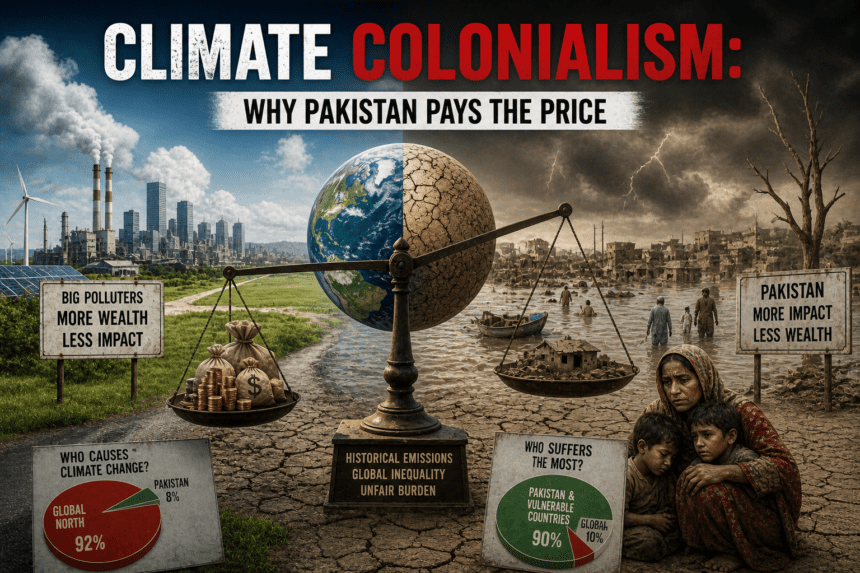
Pakistan’s climate argument is brutally simple: it did little to create the crisis, yet it keeps getting hammered by the bill. The country contributes less than 1% of global greenhouse-gas emissions, but it sits among the world’s most climate-vulnerable states, facing repeated shocks from floods, heat, drought, glacial melt and crop stress. That imbalance is exactly why the phrase “climate colonialism” has gained traction here — the idea that poorer countries are suffering the consequences of a problem driven largely by richer, historically high-emitting economies.
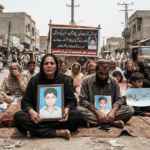
In Pakistan’s case, that injustice is not abstract. It shows up in ruined homes, wiped-out harvests and recovery bills the country can barely afford. UNDP says the cumulative effects of climate change are costing Pakistan an estimated $38 billion a year, while a recent UN country analysis puts the country’s climate financing gap at $348 billion by 2030. That is the trap in plain sight: a country with limited fiscal space is being asked to adapt to a crisis it did not meaningfully cause, while still borrowing, rebuilding and trying to keep basic development on track.
The 2022 floods became the clearest symbol of that imbalance. Attribution studies found that human-caused climate change likely increased the intense rainfall that fueled the disaster, while broader scientific work has linked the mega-flood to both climatic and human drivers. The destruction was staggering: more than 33 million people affected, around 1.7 million homes damaged or destroyed, and economic losses estimated at roughly $30 billion or more. Pakistan was not hit by “bad weather” alone. It was hit by a warming world.
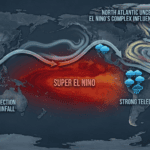
And the danger has not passed. Pakistan remains exposed to extreme heat, erratic monsoons and glacial risks across the north, where fast warming is accelerating melt and raising the threat of glacial lake outburst floods. Recent reporting on deadly 2025 flooding again tied Pakistan’s disasters to a mix of extreme rainfall and accelerated glacier melt, reinforcing a pattern scientists have been warning about for years. This is what makes the “pays the price” part so sharp: the damage is no longer occasional. It is recurring.
The second half of the colonialism argument is financial. Pakistan and other vulnerable states have long said climate finance is too slow, too small and too often structured in ways that deepen dependency. Pakistani officials have repeatedly called for grant-based climate finance and faster access to loss-and-damage support, arguing that climate justice cannot mean taking on more debt to recover from disasters driven by global emissions. UN and policy documents echo that concern, pointing to serious barriers in accessing international climate funds even as vulnerability keeps rising.
That is why the phrase “climate colonialism” resonates politically as well as morally. It suggests that the old hierarchy never really disappeared; it just changed form. Wealthy countries industrialized, emitted for decades and built prosperity on carbon-heavy growth. Countries like Pakistan, with far smaller historical responsibility, now face the fallout — and are still expected to navigate a global financial system where money, rules and technology remain concentrated elsewhere. The result is a familiar pattern: those least responsible are left with the hardest adaptation burden.
For Pakistan, then, this is not only an environmental story. It is a development story, a debt story and, frankly, a justice story. The country is being forced to spend scarce resources on survival while richer nations still move too slowly on emissions cuts and climate finance. That is the heart of the complaint — not that Pakistan is uniquely unlucky, but that the global system still allows climate harm to flow downhill, from the historically powerful to the structurally exposed.