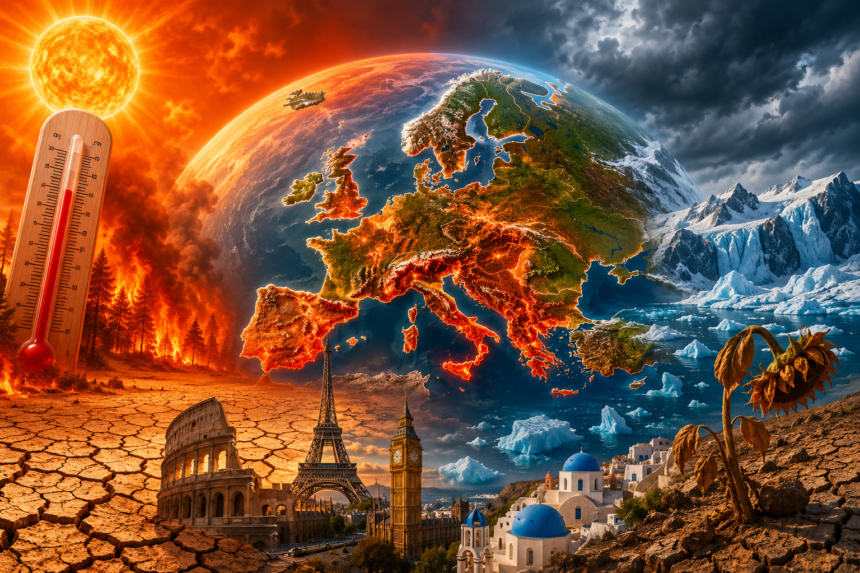
Europe is warming at roughly twice the global rate, a trend that is fundamentally reshaping the continent’s climate, economy, and public health. Since the 1980s, temperatures across Europe have risen at an average of 0.5 degrees Celsius per decade, leaving scientists to grapple with why this specific region is bearing the brunt of the crisis.
The primary driver is the continent’s geography. Europe sits at a latitude where landmasses are warming faster than oceans. Because much of the continent is land-locked or situated in the mid-to-high latitudes, it lacks the cooling buffer provided by vast water bodies. As the Arctic continues to thaw at an alarming pace, the resulting loss of sea ice and snow cover creates a feedback loop: darker surfaces absorb more solar radiation, further accelerating local heating.
Atmospheric circulation patterns are also shifting. The jet stream, which historically dictated Europe’s weather, has become increasingly “wavy” and sluggish. This phenomenon causes weather systems to stall, locking regions into prolonged heatwaves or persistent, destructive flooding. The brutal heatwaves that paralyzed Southern Europe last summer were not anomalies; they are increasingly the new baseline for a region struggling to adapt its aging infrastructure.
The economic cost is mounting. The insurance industry, once a quiet observer of climate data, is now sounding the alarm. In countries like Italy and Greece, agricultural yields for staples like olives and grapes have plummeted, while infrastructure—from rail lines to power grids—faces frequent, climate-induced failure. The European Environment Agency (EEA) has pointedly noted that the continent is “the fastest-warming region in the world,” a status that complicates everything from energy policy to immigration flows.
Critics of current policy argue that European governments remain locked in a cycle of reactive measures. While the European Green Deal aims for net-zero emissions by 2050, the current rate of warming is already outpacing many of the projected adaptation timelines. Scientists warn that even if global emissions were to vanish tomorrow, the thermal inertia already baked into the European climate system guarantees more extreme weather for decades.
The reality is that Europe is no longer just observing a global crisis from a distance. It is at the epicenter of a local one. As the continent enters another summer, the debate is shifting from how to prevent the warming to how to survive the consequences of a landscape that is fundamentally changing beneath its feet.