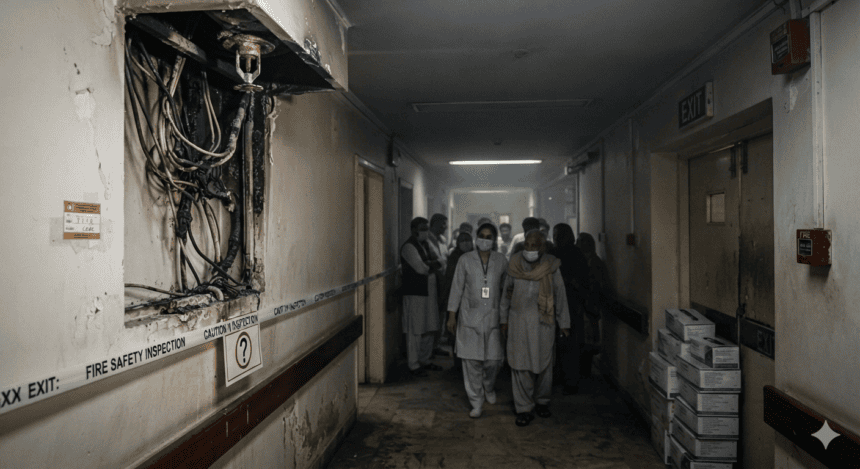
The Federal Government Poly Clinic is operating without a functional fire suppression system, a stark safety failure that has left patients and staff vulnerable just weeks after a deadly blaze at the Pakistan Institute of Medical Sciences (PIMS).
A recent internal safety audit reveals that the hospital’s primary fire hydrants are clogged with debris, and the emergency exits in the main surgical ward remain permanently locked. These are not merely administrative oversights; they are mechanical failures in a facility that houses hundreds of high-risk patients daily.
The PIMS incident in October, which claimed lives and forced an emergency evacuation, served as a grim warning for capital hospitals. Yet, the situation at Poly Clinic—the second-largest public sector hospital in Islamabad—suggests that lessons have not been learned.
“We are sitting on a powder keg,” said a senior medical officer who requested anonymity due to fear of departmental reprisal. “The oxygen supply lines run right next to electrical panels that haven’t been serviced since 2019. If a spark jumps, there is no suppression system to stop it.”
The audit report, which has been forwarded to the Ministry of National Health Services, notes that fire extinguishers placed throughout the corridors are either expired or lack the pressure required to discharge. Smoke detectors in the intensive care unit are disconnected, leaving the most critical patients without an early warning system.
Hospital administration officials claim the maintenance budget has been tied up in bureaucratic approvals for months. They argue that upgrading a facility of this scale requires specialized contractors, and the bidding process has stalled at the ministerial level.
For the families in the waiting rooms, these excuses offer little comfort.
The health ministry has yet to issue a timeline for the repairs. Until the safety systems are brought up to code, the hospital remains a high-stakes gamble for everyone inside.