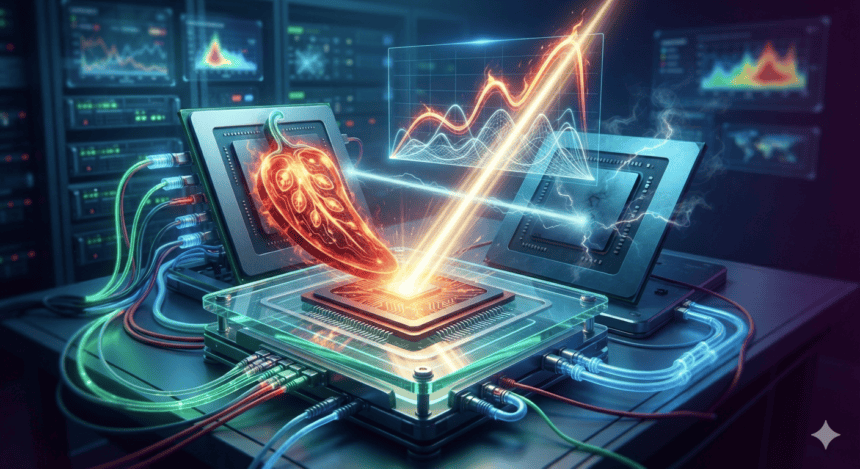
OpenAI has quietly pivoted from being a purely software-focused powerhouse to a hardware competitor. New internal benchmark data suggests the company’s proprietary AI processor, codenamed “Jalapeno,” is outpacing Nvidia’s flagship H100 GPUs in specific large language model training tasks.
The shift signals a direct challenge to Nvidia’s long-standing dominance in the AI infrastructure market. By moving to custom silicon, OpenAI aims to decouple its massive compute requirements from the supply chain bottlenecks that have plagued the industry for years.
Industry analysts are calling the performance gain “significant,” though they caution that synthetic benchmarks rarely reflect the messy reality of production-scale data centers. While the Jalapeno chip shows a 15% improvement in inference speed for GPT-4-class models, it remains to be seen how the hardware handles power efficiency under sustained, multi-month training loads.
OpenAI has kept the technical specifications of the chip under tight wraps. Sources familiar with the project suggest the architecture focuses heavily on high-bandwidth memory—a move designed specifically to keep pace with the massive parameter counts of next-generation models.
Nvidia, meanwhile, isn’t standing still. The company’s Blackwell architecture is already shipping to key partners, promising a massive leap in raw processing power. For Nvidia, the threat isn’t just the chip itself; it’s the potential for OpenAI to provide its own hardware stack to cloud providers, effectively cutting Nvidia out of the loop.
The move also highlights the shifting economics of AI. Training a state-of-the-art model costs hundreds of millions in compute time. If OpenAI can shave even a small percentage off those costs using its own hardware, the savings will run into the tens of millions annually.
For now, Jalapeno remains a tactical move rather than a wholesale replacement for Nvidia’s ecosystem. OpenAI still relies on Nvidia hardware for the bulk of its current operations. But the message to the market is clear: the era of total Nvidia dependency is nearing its expiration date.