By using this site, you agree to the Privacy Policy and Terms of Use.
Accept
Media HydeMedia Hyde
  • Home
  • Politics
  • Education
  • Entertainment
  • Sports
  • Blogs
  • Business & Commerce
  • Others
    • Religious
    • Metropolitan
    • Climate and Weather
Font ResizerAa
Media HydeMedia Hyde
Font ResizerAa
  • Home
  • Politics
  • Education
  • Entertainment
  • Sports
  • Blogs
  • Business & Commerce
  • Others
    • Religious
    • Metropolitan
    • Climate and Weather
Follow US
© 2026 Media Hyde Network. All Rights Reserved.
Religious

Qur’an Mentioned Rainbow-Like Mountains 1,400 Years Ago, Similar Formations Seen Today in China

Last updated: December 19, 2025 12:53 pm
Anoosha Malik
Share
SHARE


Qur’anic Description of Multicolored Mountains Sparks Reflection as Science Reveals Similar Formations

More than fourteen centuries ago, the Qur’an described a striking natural phenomenon: mountains displaying different colors and layers. Today, modern geological discoveries are drawing attention to this description, as scientists observe multicolored mountain formations in various parts of the world.

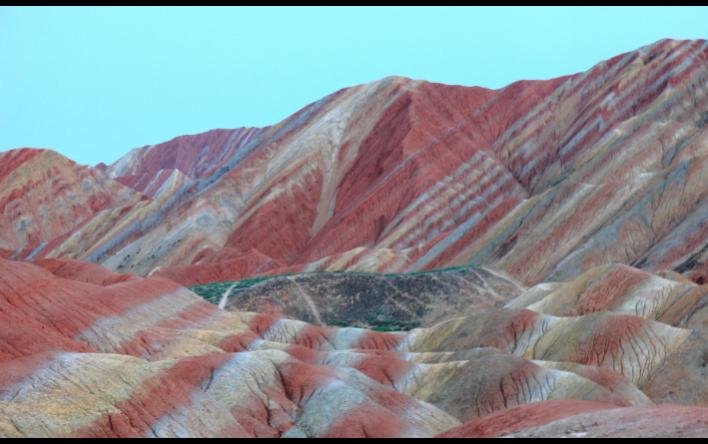
One such example is found in China’s Zhangye Danxia, where vast mountains appear painted with vivid streaks of red, white, yellow, brown, and black. These so-called “rainbow mountains” are formed through millions of years of sedimentation, mineral deposits, and oxidation processes, resulting in clearly visible layered rock patterns.

The Qur’anic verse from Surah Fatir (35:27) states that mountains contain streaks of varying colors — white, red in different shades, and even deep black. While the verse does not specify locations or scientific mechanisms, its general description closely matches what geologists now observe through advanced research and field studies.

Experts explain that these colors arise due to differences in mineral composition, including iron oxides and other elements that react with air and moisture over time. Layers are formed as sediments accumulate over long geological periods, later exposed through tectonic movements and erosion.

For many believers, this alignment between ancient scripture and modern observation serves as a reminder of the Qur’an’s emphasis on reflection upon the natural world. Rather than presenting itself as a scientific manual, the Qur’an frequently invites readers to observe nature as signs pointing toward deeper understanding and contemplation.

Scholars note that such verses encourage curiosity, observation, and appreciation of the Earth’s complexity. As scientific exploration continues to uncover remarkable natural formations, these discoveries often renew interest in classical religious texts and their descriptions of the world.

The discussion surrounding multicolored mountains highlights an ongoing dialogue between faith and science — one that continues to inspire reflection across cultures and generations.


Share This Article
Email Copy Link Print
Previous Article Historic Step Taken to Implement National Blood Transfusion Policy with SIFC Support
Next Article Severe Fog Disrupts Travel as Motorway Sections Shut Across Pakistan
Leave a Comment

Leave a Reply Cancel reply

Your email address will not be published. Required fields are marked *

Sponsored Ads

Stay Connected

FacebookLike
XFollow
InstagramFollow
YoutubeSubscribe
WhatsAppFollow
ThreadsFollow
Sindh Schools to Close for Two-Month Summer Break Starting June 1
Education
May 13, 2026
Pakistan Targets Tech Workforce with 20,000 AI Training Slots
Education
May 13, 2026
Tokyo University Launches Fully Autonomous Lab Where Robots Run the Show The lights are on at the University of Tokyo’s newest chemistry lab, but the lab coats are gone. In a move that signals a shift for experimental science, the university has officially opened a facility where robots handle the entire research cycle—from mixing chemicals to analyzing results—without a single human in the room. This isn’t just a room with a few automated arms. It’s a closed-loop system designed to hunt for new materials for batteries and semiconductors at speeds that make traditional methods look like they’re standing still. The AI designs the experiment, the robots execute it, and the data feeds right back into the AI to decide what happens next. "The goal is to remove the bottleneck of human physical labor," a researcher involved in the project’s pilot phase said. "A human can do maybe ten experiments a day. This system won't stop at ten, and it doesn't need to go home at 5:00 PM." The stakes are high. Japan is currently locked in a global race to find more efficient materials for the next generation of electric vehicle batteries. By cutting humans out of the "pipette-and-wait" cycle, the university expects to compress years of trial-and-error into a few weeks of non-stop robotic iteration. It’s a response to a looming crisis, too. Japan’s shrinking workforce means there are fewer young scientists entering the field every year. Automating the grunt work isn't just about speed; it’s about survival in a country where human talent is becoming a scarce resource. Critics often worry that "robot-run" means "job-lost," but the university’s lead engineers argue the opposite. They say the move frees up researchers to actually think, rather than spending eight hours a day performing repetitive liquid handling. The robots don't get bored, they don't make clerical errors, and they don't suffer from "Friday afternoon" fatigue that can ruin a data set. The lab is currently focused on thin-film materials, but the team plans to scale the technology to other branches of chemistry soon. If it works, the image of the lone scientist hunched over a workbench might soon be a relic of the past. The lab is running right now. It’ll be running tomorrow morning. And it won't need a coffee break to get through the night.
Tokyo University Launches Fully Autonomous Lab Where Robots Run the Show
Education
May 13, 2026
Pakistan Offers New Higher Education Scholarships to Bangladeshi Students
Education
May 13, 2026
Private Schools Defy Punjab Government’s Revised Summer Vacation Schedule
Education
May 13, 2026
HEC Drops Paperwork: Fully Online Degree Attestation Goes Live Nationwide
Education
May 13, 2026

You Might Also Like

Religious

Pope Leo XIV Urges Lebanon’s Religious Leaders to Stand Against Intolerance

By
Wajeeha Batool
Religious

Pakistan Extends Private Hajj Booking Deadline by Five Days  Over 4,500 Seats Still Open

By
Wajeeha Batool
Religious

US Muslims Show Historic Shift Toward Republicans in 2024

By
Sana Mustafa
Religious

Rabbi Accused of War Crimes Chosen for Israel’s Flagship Independence Day Ceremony

By
Syed Jarri Abbas
Media Hyde Media Hyde Dark
Facebook Twitter Youtube Rss Medium

About US

Media Hyde Network: Your instant connection to breaking stories and live updates. Stay informed with our real-time coverage across politics, tech, entertainment, and more. Your reliable source for 24/7 News.

Top Categories
  • Headline
  • Politics
  • Entertainment
  • Education
  • Sports
  • Religious
  • Metropolitan
  • Climate and Weather
Usefull Links
  • Contact Us
  • Disclaimer
  • Privacy Policy
  • Cookies Policy
  • Advertising Policy
  • Terms & Conditions

© 2025 Media Hyde Network. All Rights Reserved.

Welcome Back!

Sign in to your account

Username or Email Address
Password

Lost your password?