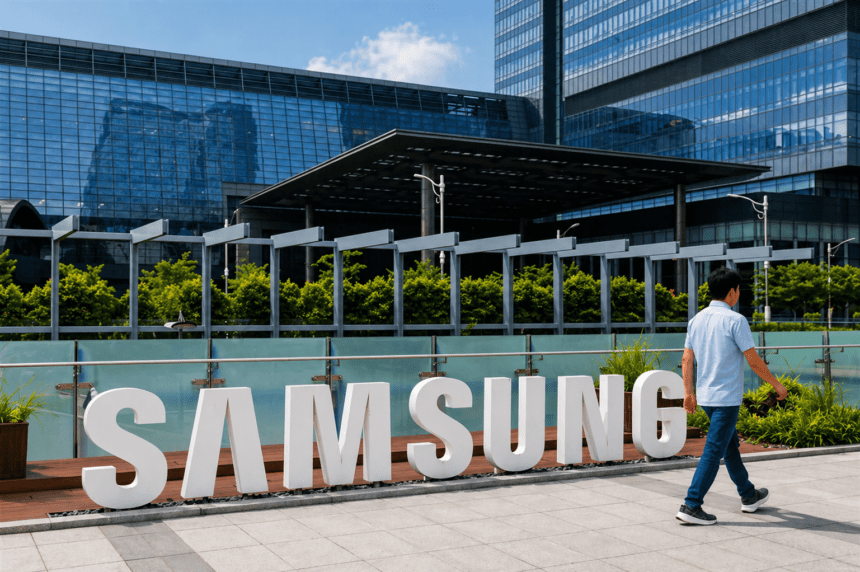
Samsung Electronics is moving to restructure parts of its consumer-facing business as weaker demand, rising component costs and intensifying competition from Chinese brands squeeze profitability in televisions, home appliances and smartphones. Fresh reporting out of Seoul says the company has started reworking its TV and appliance operations and is weighing deeper changes in China, where local competitors have grown more aggressive on both price and technology.
The timing matters. Samsung is heading into its first-quarter 2026 earnings call on April 30, after already guiding for roughly 133 trillion won in sales and about 57.2 trillion won in operating profit. Those headline numbers look strong, but they have been driven largely by semiconductors rather than the consumer businesses now under pressure. In other words, the company’s chip boom is buying it some room while it cleans up weaker units.
What’s changing on the ground appears less like a dramatic retreat and more like a hard reset. Local reports say Samsung has begun outsourcing production of some lower-margin home appliances, including dishwashers and microwave ovens, as it shifts toward a structure more tightly focused on profitability. Other reports suggest the company is consolidating global production and sales operations in categories where margins have been thinning.
China sits at the center of the problem. Samsung’s position in the Chinese consumer electronics market has faded for years, and the competitive gap has become harder to ignore. In smartphones, Chinese brands continue to dominate their home market. Counterpoint Research’s latest data for China show Huawei holding the top position in the first quarter of 2026, while the market overall shrank 4% year over year as memory shortages pushed up costs. Samsung does not appear among the leading vendors in that ranking, which says plenty on its own.
That pressure is not limited to phones. In home appliances and TVs, Chinese manufacturers have spent years closing the technology gap while staying brutally competitive on price. Recent coverage in South Korea says Samsung’s share in some Chinese appliance segments has become marginal, making it difficult to justify the same level of investment in businesses where local players can move faster and sell cheaper.
Costs, meanwhile, are moving the wrong way. TrendForce said in February that first-quarter 2026 contract prices for conventional DRAM were expected to jump by around 90% to 95% quarter over quarter, while NAND flash prices were projected to rise 55% to 60%. That kind of surge feeds directly into the cost of making smartphones, TVs and other electronics, especially at a time when end-market demand is not strong enough to easily absorb higher retail prices.
That helps explain why Samsung seems to be drawing a clearer line between businesses it wants to defend and businesses it may streamline. Chips remain the obvious priority, and the company is also expanding in adjacencies tied to data centers and infrastructure. The same day reports surfaced about restructuring pressure in consumer units, Samsung announced the acquisition of FläktGroup, a German HVAC company, for 1.5 billion euros, underlining where management sees stronger long-term demand.
For Samsung, this is a familiar but uncomfortable moment. The company still has enormous scale, one of the strongest consumer brands in electronics, and the balance-sheet strength to absorb a difficult transition. But scale alone doesn’t solve a margin problem. When Chinese rivals are willing to fight on price, and component inflation keeps eating into costs, even a giant ends up making sharper choices than it would like.
The bigger question now is how far Samsung is willing to go. If the restructuring remains focused on outsourcing and trimming weaker lines, investors may see it as overdue discipline. If it turns into a broader pullback from large parts of the China consumer market, that would be a more consequential admission: that in some of the world’s toughest electronics battlegrounds, the old Samsung playbook no longer works as well as it used to.