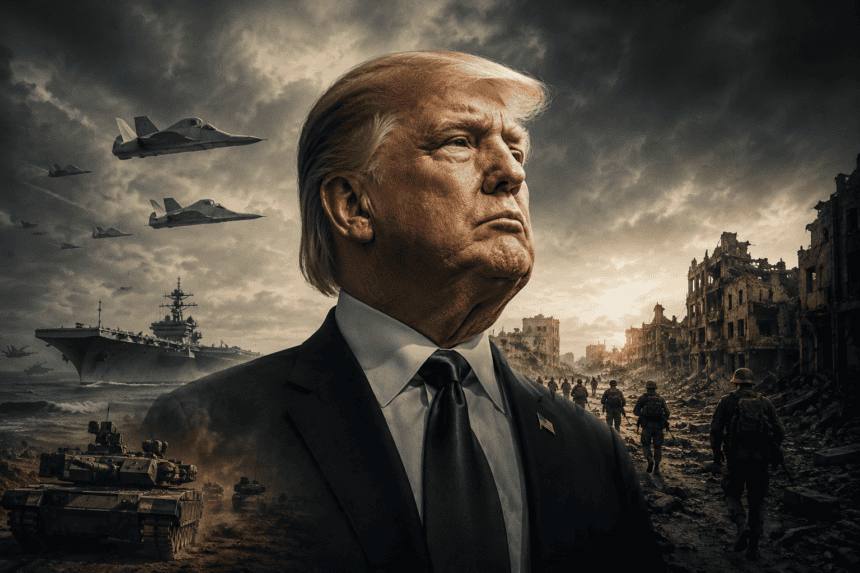
Donald Trump’s return to the Oval Office comes with a familiar promise: “peace through strength.” It is a slogan that relies on the assumption that American military might is the ultimate arbiter of global disputes. Yet, as he begins his second term, the reality of 2025 looks nothing like the world he left in 2021. The limitations of U.S. firepower are no longer theoretical; they are being tested in real-time across three continents.
The conflict in Ukraine is the most immediate friction point. Trump has signaled a desire to force a quick end to the fighting, but the battlefield reality remains stubborn. Two years of intense attrition have shown that even massive infusions of American munitions cannot instantly turn the tide when the opponent is a nuclear-armed power willing to accept staggering casualties. The U.S. defense industrial base is struggling to keep pace with the sheer volume of artillery shells required for high-intensity modern warfare.
In the Middle East, the challenge is different but equally daunting. The U.S. military remains the world’s most capable force for conventional engagement, yet that power has proven surprisingly blunt against asymmetric threats. Strikes on Houthi positions in Yemen and warnings to regional proxies have failed to deter attacks on global shipping or stabilize the Levant. Trump’s team is discovering that “maximum pressure” campaigns of the past often lead to escalation rather than submission, especially when regional actors calculate that the U.S. lacks the domestic appetite for a full-scale ground war.
The lesson from Iraq and Afghanistan is etched into the minds of modern military commanders: tactical dominance does not equate to strategic victory. Trump’s advisors are now grappling with the cost of maintaining a global footprint while domestic voters demand a focus on the U.S. border and the economy. Every carrier strike group deployed to the South China Sea or the Mediterranean is a resource pulled from elsewhere, and the Pentagon is running out of places to cut.
China’s rapid military modernization has changed the calculus in the Pacific. U.S. wargames routinely show that a conflict over Taiwan would be a brutal, high-tech slog with no guarantee of a decisive American win. The era of the U.S. military exercising uncontested control over global theaters is over. Trump is finding that the world is no longer a collection of chess pieces to be moved, but a landscape of entrenched interests that do not bow to the threat of force alone.
The president-elect’s preference for transactional diplomacy suggests he may try to bypass traditional military posturing. He wants deals, not deployments. But deals require leverage, and in the current climate, that leverage is increasingly elusive. If the U.S. cannot win the wars it starts and cannot afford the wars it threatens, the next four years will be defined by a difficult retreat from the myth of absolute American omnipotence.