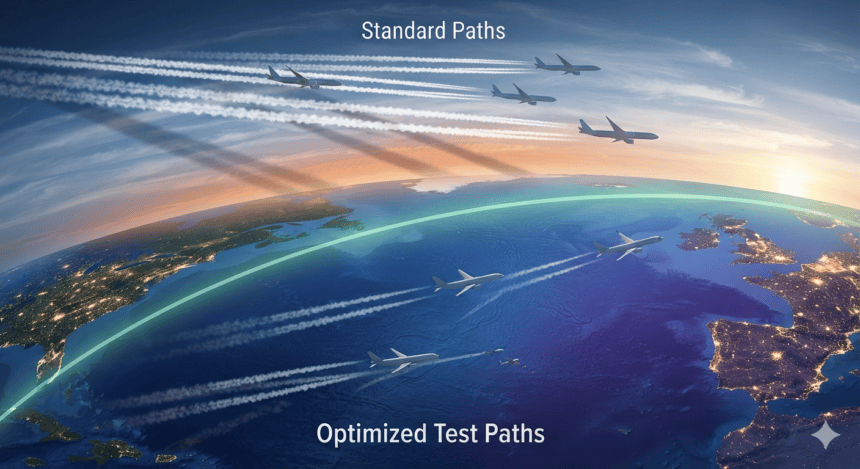
The U.K. government is launching a series of flight path trials aimed at reducing the environmental impact of aviation, specifically targeting the formation of contrails. By adjusting cruise altitudes by as little as 2,000 feet, officials hope to significantly curb the warming effect these vapor trails have on the atmosphere.
Contrails—the white, cloud-like streaks left by jet engines—trap heat in the atmosphere. While carbon emissions are the primary focus of aviation’s climate footprint, scientists have long argued that these ice-crystal clouds contribute nearly as much to global warming as the fuel burned by the planes themselves.
The trials, led by the Department for Transport and the Civil Aviation Authority, will involve real-time adjustments to flight paths across the Atlantic. Airlines participating in the program will receive data on atmospheric moisture levels, allowing pilots to steer clear of the specific “ice-supersaturated” zones where contrails are most likely to form and persist.
“Aviation must evolve if we are to meet our net-zero targets,” said a transport official involved in the project. “Fuel efficiency is only half the battle. If we can manage the non-CO2 effects of flying, we gain a massive advantage without needing to overhaul current engine technology.”
The challenge lies in the trade-off. Diverting a flight path to avoid a contrail-prone layer of the atmosphere often requires burning more fuel. The U.K. trials aim to determine if the reduction in long-term warming from suppressed contrails outweighs the immediate increase in carbon emissions from the extra fuel consumed during the detour.
Previous small-scale studies by organizations like Breakthrough Energy have suggested that avoiding these specific zones can cut the warming impact of a flight by up to 60%. However, scaling this across the busy Atlantic corridor—where air traffic control already manages complex, overlapping routes—remains a logistical hurdle.
The aviation industry is watching the results closely. If the data confirms that altitude adjustments are both manageable and climate-positive, it could become standard procedure for international carriers within the next few years.
For now, the project remains in the data-gathering phase. Success will be measured not just by the disappearance of white streaks in the sky, but by a net reduction in the total heat trapped by the aviation sector.