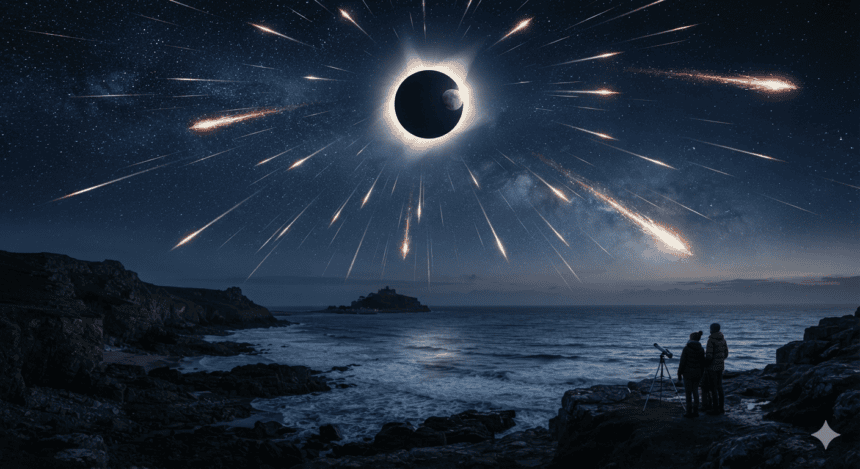
The UK sky is set for a rare double feature this Wednesday, as a partial solar eclipse and the peak of the Draconid meteor shower converge.
While the eclipse will offer a fleeting daytime spectacle, the meteor shower promises a more extended show for those with clear skies after sunset.
The solar eclipse begins shortly after 6:00 p.m. GMT, though the timing is tight. For most of the UK, the moon will take its bite out of the sun just as it dips toward the horizon. In Scotland and parts of Northern England, observers have the best chance to catch the event before the sun slips out of view. In the south, the sun will likely set while the eclipse is still in its early stages, making the event difficult to spot without a clear, unobstructed western horizon.
Astronomers warn that viewing the eclipse requires caution. Even with the sun low in the sky, looking directly at it without certified solar filters can cause permanent eye damage.
Once the sun disappears, the focus shifts to the Draconid meteor shower. Unlike many other showers that peak in the dead of night, the Draconids are known for being active during the early evening hours. The shower is caused by debris left behind by the comet 21P/Giacobini-Zinner. As Earth passes through this trail of dust and ice, the particles burn up in the atmosphere, creating streaks of light.
The Draconids are notoriously unpredictable. Most years, observers might see only a handful of meteors per hour. Occasionally, the shower produces a sudden “outburst,” sending dozens or even hundreds of shooting stars across the sky in a short window.
For the best view, head away from urban light pollution. The meteors will appear to radiate from the constellation Draco, high in the northern sky. No special equipment is needed; the human eye remains the best tool for spotting the faint flashes against the dark backdrop.
Whether the event turns into a spectacular celestial display or a quiet evening of stargazing depends on the comet’s debris density this year. Either way, the timing provides a rare opportunity to catch two distinct astronomical phenomena in a single night.