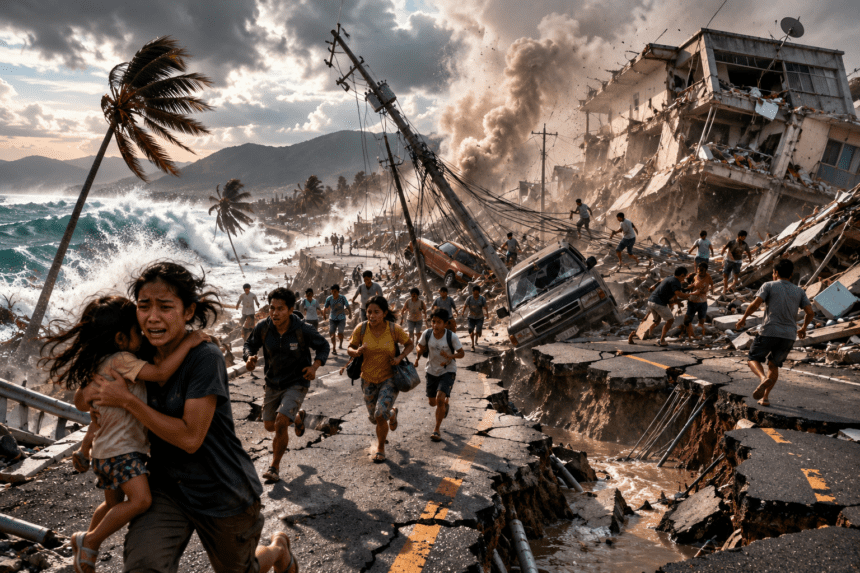
A powerful offshore quake struck Mindanao on Monday morning, collapsing buildings, triggering a tsunami, and sending thousands fleeing to higher ground.
A powerful magnitude 7.8 earthquake struck off the southern coast of the Philippines on Monday, killing at least 32 people, injuring more than 200 others, and sending a one-metre tsunami crashing into nearby coastlines. The quake hit the Mindanao region — the country’s second-largest island — early in the morning, just as schools were beginning their first day of the new academic year and flag-raising ceremonies were underway across the region.
The United States Geological Survey confirmed the offshore quake struck near General Santos City in Sarangani province, at the southernmost tip of Mindanao island. Buildings shook violently across multiple provinces. Social media footage captured dozens of terrified schoolchildren crouching on the ground as the earth swayed violently beneath them in Davao Occidental province.
“It’s devastating. The bridge suffered cracks and a shrine with a huge cross has collapsed.”
Buildings Collapse, Infrastructure Damaged
In General Santos City — home to approximately 720,000 people — several buildings collapsed or were severely damaged. Photos and video from the scene showed crumbled convenience stores, sheets of concrete stacked upon each other, and a collapsed fast food restaurant. A school roof in Davao Del Sur also caved in, though no injuries were reported at that location. A mosque was damaged in a southern province and a landslide was triggered in the hills above Sarangani, killing several people.
Key infrastructure across the southern region sustained significant damage. A bridge developed cracks and a large roadside shrine collapsed in the coastal town of Maasim. Disaster authorities confirmed that evacuation of coastal villages was underway immediately after the quake, with residents urged to move inland and to higher ground without delay.
Tsunami Strikes Coastlines
The earthquake triggered a one-metre (roughly three-foot) tsunami that struck coastal areas in the region. Smaller waves were also recorded in parts of Indonesia and Palau. The Pacific Tsunami Warning Center confirmed the tsunami threat had largely passed approximately five hours after the initial quake, though authorities continued to urge caution along vulnerable coastal stretches.
Witnesses in Indonesia’s northern city of Manado also reported strongly feeling the quake. Indonesian disaster mitigation authorities said no damage had been reported on their side of the border. Water in some coastal areas was reported to have briefly receded in the immediate aftermath of the quake before returning to normal levels.
President Orders Evacuation
Philippine President Ferdinand Marcos Jr. urged all residents in affected coastal areas to evacuate to higher ground immediately following the quake, as tsunami warnings were issued across the southern region. The Office of Civil Defense confirmed that at least 32 people had been killed — mostly in collapsed buildings and landslides — with thousands of villagers displaced from their homes.
Among the dead, seven fatalities were reported in General Santos City alone. Additional deaths were caused by falling debris, a damaged mosque, and a landslide across the southern provinces of Sarangani, South Cotabato, and Davao Occidental. Rescue teams were deployed across the affected provinces as the full extent of the damage continued to emerge.
“The quake hit as children lined up for their first day of school — the timing made an already devastating disaster even more harrowing.”
Philippines Among World’s Most Earthquake-Prone Nations
The Philippines sits on the Pacific Ring of Fire, one of the most seismically active zones on Earth, and regularly experiences powerful earthquakes. The country’s southern Mindanao region has been struck by several major quakes in recent decades. Authorities have long urged residents in coastal and mountainous areas to follow evacuation protocols immediately following any strong tremor.
Relief operations were ongoing as of Monday afternoon, with the full death and injury toll expected to rise further as rescue teams reach more remote areas. International disaster response agencies were monitoring the situation closely.