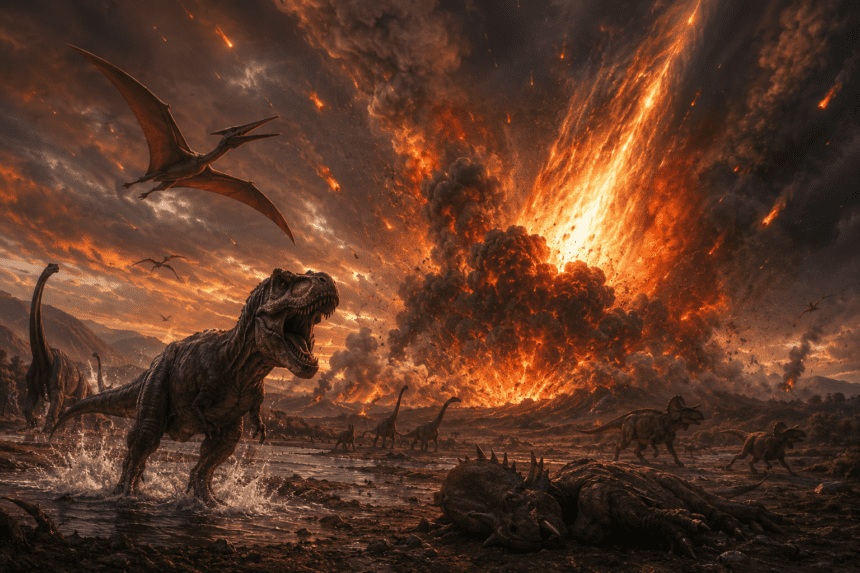
Sixty-six million years ago, a perfect storm of cosmic and geological catastrophe erased the dominant life forms on Earth — and reshaped the planet forever.
For over 160 million years, dinosaurs ruled the Earth. They evolved into more than a thousand species, spread across every continent, and dominated ecosystems from the humid tropics to the polar forests. Then, in a geological instant, they vanished. Understanding what brought about their end is one of science’s most compelling detective stories — and the answer involves an asteroid, volcanic fire, and a world already beginning to unravel.
“The extinction wasn’t just bad luck — it was the collision of multiple catastrophes that created conditions no large land animal could survive.”
The Asteroid That Changed Everything
The dominant scientific explanation centers on the Chicxulub impactor — a massive asteroid or comet approximately 10 to 15 kilometres wide that struck what is now the Yucatán Peninsula of Mexico approximately 66 million years ago. The impact released energy billions of times greater than any nuclear weapon ever made. In the immediate vicinity, everything was incinerated. Miles-high tsunamis swept across coastlines. The sky turned to fire as superheated debris rained back down across the globe.
The longer-term consequences proved even more devastating. A thick cloud of vaporised rock, ash, and soot blanketed the atmosphere, blocking sunlight for months — possibly years. Without sunlight, photosynthesis collapsed. Plants died. The herbivores that depended on them perished. And the carnivores that ate the herbivores followed. It was a cascading collapse of the entire food web, from the bottom up.
Geologists found critical evidence in a thin layer of iridium — an element rare on Earth but common in asteroids — embedded in rock strata around the world at the precise geological boundary marking this extinction event, known as the Cretaceous-Paleogene, or K-Pg, boundary. The Chicxulub crater itself, a 93-mile-wide structure discovered in 1991 beneath the Gulf of Mexico, confirmed the impact site beyond doubt.
A World Already Under Stress
The asteroid was perhaps the decisive blow, but it did not strike a healthy world. In the millions of years leading up to the impact, the planet was already experiencing significant ecological strain. Global temperatures had begun to fluctuate due to vast volcanic eruptions in what is now India — a geological event known as the Deccan Traps. These eruptions released enormous quantities of carbon dioxide and sulphur dioxide into the atmosphere, disrupting climate patterns and acidifying the oceans.
Research published in leading scientific journals has shown that six major dinosaur families were already in decline in the 10 million years before the asteroid struck, likely due to global climate cooling and a drop in the diversity of herbivorous dinosaurs. With fewer plant-eaters, the entire food pyramid wobbled. The asteroid did not cause the extinction alone — it delivered a fatal strike to a world already weakened.
Who Survived — and Why
Not everything perished. Small mammals, many of which lived underground or in burrows, survived the initial catastrophe by sheltering from the heat and later subsisting on seeds, insects, and decaying matter. Crocodilians, turtles, and certain fish also endured. Most remarkably, one lineage of dinosaurs survived entirely: birds. Descended from small, feathered theropod dinosaurs, birds were able to exploit ecological niches that larger dinosaurs could not access.
The aftermath of the extinction reshaped the planet in ways still visible today. With the great herbivore dinosaurs gone, dense forests flourished and spread across continents. Rivers stabilised, riverbanks firmed, and new ecosystems formed. The vacuum left by the dinosaurs gave mammals the opportunity to diversify rapidly — and over the following tens of millions of years, they evolved into the vast range of species, including humans, that populate the Earth today.
“The dinosaurs’ extinction was not an ending — it was a reset. One that made room for everything that came after, including us.”
A Mystery Still Unfolding
Science continues to refine its understanding of this great extinction. Recent studies have examined how wildfire, acid rain, and the sudden “impact winter” interacted to magnify the devastation. Other researchers are investigating whether the angle and speed of the Chicxulub impact made it uniquely destructive — a slightly different trajectory might have caused far less global damage. The story of the dinosaurs’ end, it turns out, is also the story of our beginning.