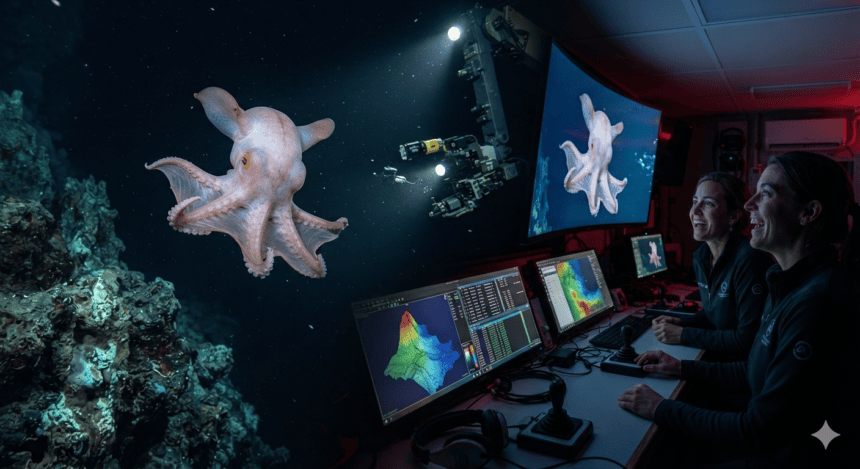
Marine scientists have celebrated the rare sighting of a Dumbo octopus, a deep-sea creature that is among the ocean’s most mysterious and least-studied species. The encounter has provided researchers with a valuable opportunity to observe the animal in its natural habitat and gather new information about life in the deep ocean.
The Dumbo octopus, named after Disney’s famous elephant because of its ear-like fins, lives at depths ranging from 3,000 to 7,000 meters (9,800 to 23,000 feet), making it one of the deepest-living octopus species known to science.
The rare sighting was recorded by a remotely operated underwater vehicle (ROV) equipped with high-definition cameras during a deep-sea exploration mission. Scientists observed the octopus gracefully swimming above the seafloor using its distinctive fins, while occasionally extending its arms to search for food.
Researchers say the Dumbo octopus feeds primarily on small crustaceans, worms, snails, and other tiny marine organisms found on the ocean floor. Unlike many shallow-water octopus species, it swallows its prey whole rather than tearing it apart.
Marine biologists believe the discovery offers important clues about how animals survive in one of Earth’s harshest environments, where sunlight never reaches, temperatures remain near freezing, and water pressure is hundreds of times greater than at the surface.
Scientists are using advanced technologies, including deep-sea cameras, robotic submarines, and environmental sensors, to better understand the biodiversity of the deep ocean. They emphasize that many deep-sea species remain undiscovered, and every expedition has the potential to reveal entirely new forms of marine life.
Experts also stress the importance of protecting deep-sea ecosystems from threats such as climate change, pollution, and future deep-sea mining activities, which could disturb fragile habitats that have existed for millions of years.
Researchers hope continued exploration will uncover more rare species like the Dumbo octopus and improve humanity’s understanding of the largest and least explored habitat on Earth.