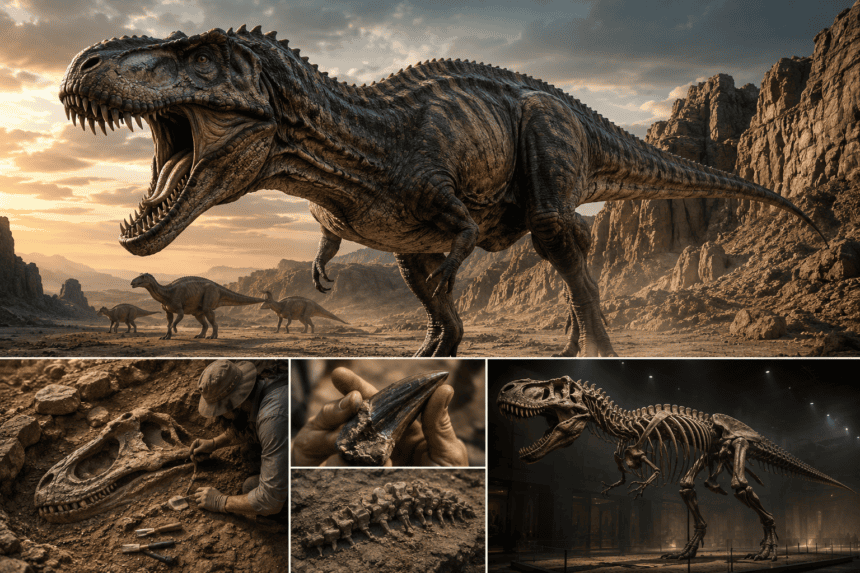
Scientists have uncovered new insights into Carcharodontosaurus, one of the largest meat-eating dinosaurs ever to roam the Earth. The latest research is helping paleontologists better understand the giant predator’s anatomy, hunting behavior, and role in prehistoric ecosystems that existed nearly 95–100 million years ago during the Late Cretaceous Period.
Researchers examined fossil remains, fossilized skull fragments, and advanced 3D digital reconstructions to study the dinosaur’s body structure in greater detail. The findings suggest that Carcharodontosaurus possessed an exceptionally powerful bite, sharp serrated teeth, and a lightweight yet strong skull designed for hunting large prey.
The dinosaur’s name means “shark-toothed lizard,” a reference to its long, blade-like teeth that closely resemble those of modern sharks. Scientists estimate that an adult Carcharodontosaurus could grow 12 to 13 meters (39–43 feet) long and weigh between 6 and 8 tonnes, making it one of the largest terrestrial predators known to science.
Unlike the more heavily built Tyrannosaurus rex, Carcharodontosaurus had a longer, narrower skull and was likely adapted for delivering deep, slicing bites rather than crushing bone. Researchers believe it preyed on massive herbivorous dinosaurs, including giant sauropods that lived in what is now North Africa.
The study also sheds light on the ancient ecosystems of the Sahara, which millions of years ago consisted of vast river systems, forests, and wetlands rather than the desert seen today. Fossil evidence indicates that Carcharodontosaurus shared this environment with giant crocodile-like reptiles, enormous fish, and other large dinosaurs.
Scientists emphasize that many aspects of the dinosaur’s biology remain uncertain due to the limited fossil record. However, advances in CT scanning, biomechanical modeling, and digital fossil reconstruction are enabling researchers to better understand how this giant predator moved, hunted, and evolved.
Experts believe continued fossil discoveries will reveal even more about Carcharodontosaurus and improve our understanding of the diverse predators that dominated Earth’s prehistoric landscapes.