A new scientific study has uncovered fresh clues about Spinosaurus, one of the largest and most unusual predatory dinosaurs ever to walk the Earth. The latest findings are helping paleontologists better understand how the prehistoric giant lived, hunted, and adapted to its environment nearly 95 million years ago.
Researchers analyzed newly discovered fossils along with advanced 3D computer models to reconstruct the dinosaur’s body structure and movement. The study suggests that Spinosaurus was uniquely adapted to a semi-aquatic lifestyle, spending much of its time in rivers, swamps, and coastal environments while hunting for prey.
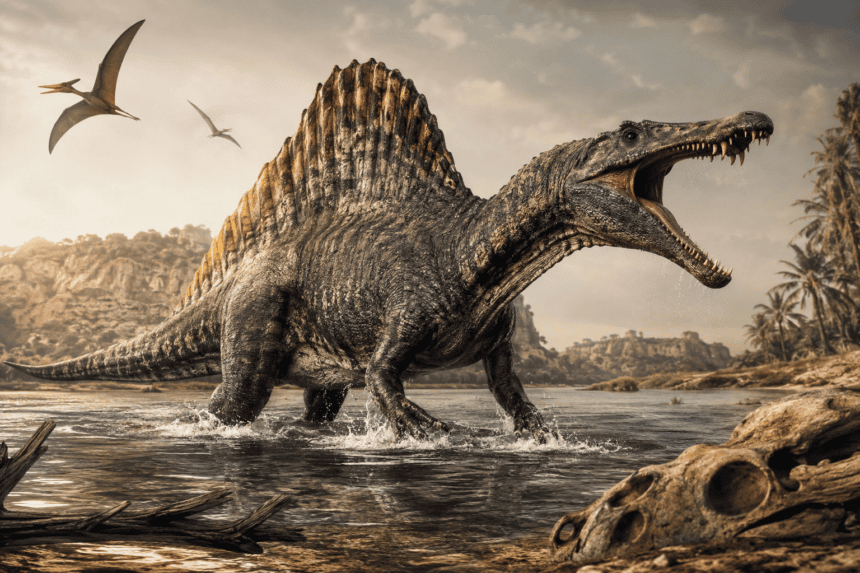
Unlike the famous Tyrannosaurus rex, Spinosaurus possessed a long crocodile-like snout filled with cone-shaped teeth, making it well suited for catching large fish. Scientists believe fish formed a major part of its diet, although it may also have preyed on smaller dinosaurs and other animals living near waterways.
One of the dinosaur’s most distinctive features was the enormous sail-like structure on its back, formed by elongated vertebral spines. Researchers continue to debate its purpose, suggesting it may have been used for display, body temperature regulation, species recognition, or attracting mates.
The latest fossil evidence also indicates that Spinosaurus had dense bones that helped it remain stable in water, while its powerful tail may have provided propulsion during swimming. These discoveries support the theory that it was among the first known dinosaurs highly adapted to an aquatic lifestyle.
Scientists emphasize that although significant progress has been made, many questions remain unanswered regarding Spinosaurus’ behavior, hunting techniques, and exact movement both on land and in water. Future fossil discoveries are expected to provide further insights into this remarkable prehistoric predator.
Experts believe the research strengthens our understanding of dinosaur evolution and demonstrates how new fossil discoveries continue to reshape scientific knowledge of Earth’s ancient ecosystems.