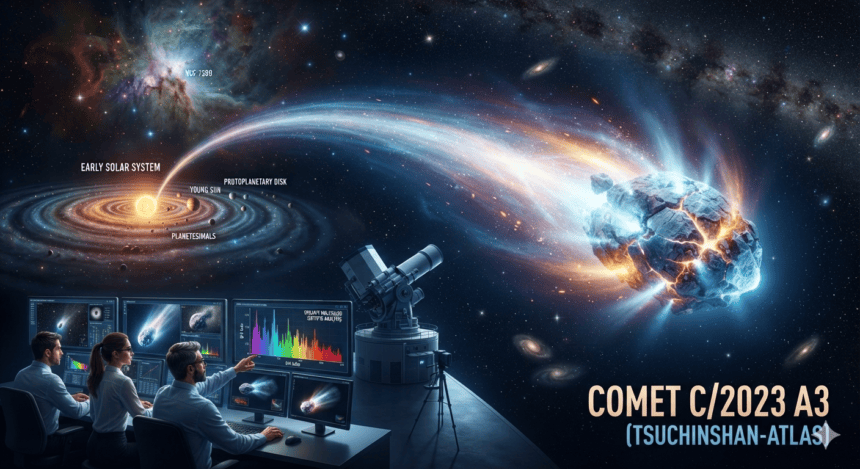
A bright comet observed by astronomers has provided scientists with valuable new clues about the origins of the early Solar System, offering fresh insights into the materials and conditions that existed more than 4.5 billion years ago.
Using powerful ground-based observatories and advanced space telescopes, researchers studied the comet’s icy nucleus, surrounding cloud of gas and dust—known as the coma—and its long glowing tail. By analyzing the light reflected and emitted by the comet, scientists identified various frozen gases, organic compounds, and dust particles preserved since the Solar System’s formation.
Scientists describe comets as “cosmic time capsules” because they contain some of the oldest and most primitive material left over from the birth of the Sun and planets. Unlike planets, many comets have remained largely unchanged for billions of years, making them valuable records of the Solar System’s earliest history.
The latest study suggests that the comet contains water ice, carbon-based molecules, and other volatile materials that may have played an important role in delivering water and the chemical building blocks of life to the early Earth. Although this theory continues to be studied, many researchers believe comets contributed to shaping Earth’s young environment.
Researchers also examined how sunlight heats the comet, causing frozen gases to sublimate and release streams of dust that create its spectacular tail. These observations help scientists better understand the physical and chemical processes that occur as comets travel through the inner Solar System.
Astronomers emphasize that every newly observed comet provides a unique opportunity to study the ancient history of our planetary system. Future observations and upcoming space missions are expected to reveal even more about how the Solar System formed and evolved over billions of years.
Experts believe these discoveries bring humanity one step closer to understanding the origins of the Sun, the planets, and ultimately, life on Earth.