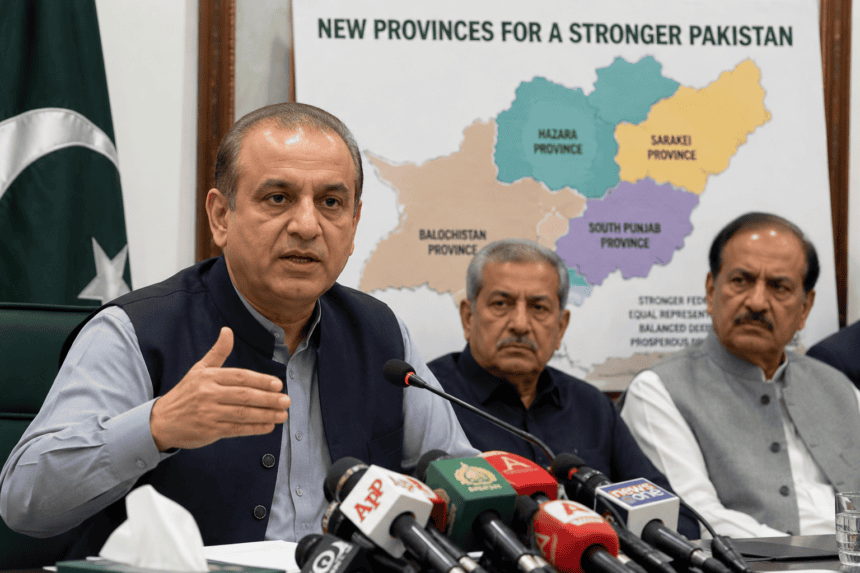
LAHORE — Aleem Khan has reignited the debate over administrative divisions in Pakistan, signaling an intensified push for the creation of new provinces. The Istehkam-e-Pakistan Party (IPP) leader, currently serving as the Federal Minister for Privatization, framed the move as a long-overdue necessity to improve governance rather than a political gambit.
Khan’s latest public push centers on the argument that Punjab’s current administrative footprint is too large to manage effectively. He told party workers in Lahore this week that the existing structure leaves the common citizen disconnected from the power centers in the provincial capital.
His proposal isn’t new, but the timing is pointed. With the federal government navigating a fragile economic recovery, critics argue that carving out new provinces invites administrative chaos and massive fiscal strain. Establishing a new provincial capital requires building a secretariat, an assembly, and a judiciary from the ground up — costs that the national exchequer can barely sustain right now.
Khan dismisses these concerns as secondary to the rights of the people. He points to the neglect of Southern Punjab, arguing that resources are consistently diverted toward central districts, leaving the periphery to wither.
“The people of these regions have been promised development for decades,” Khan said during the briefing. “They don’t need more promises. They need their own provincial assembly to hold their own representatives accountable.”
The political stakes go beyond mere administration. By championing this cause, the IPP is positioning itself as the primary advocate for regions that feel disenfranchised by the traditional Lahore-centric political elite. It’s a strategy designed to peel away support from both the PML-N and the PTI, particularly in the Saraiki-speaking belts.
However, the path forward remains blocked by constitutional hurdles. Creating a new province requires a two-thirds majority in both houses of Parliament—a threshold that currently seems out of reach given the deep polarization in the National Assembly. Without bipartisan consensus, the campaign risks becoming another cycle of rhetoric that captures headlines but stalls in the legislative pipeline.
Khan has signaled he won’t stop at press statements. He plans to take the issue to the public square, aiming to build grassroots pressure that makes it impossible for the major parties to ignore the demand.
Whether this becomes a genuine legislative shift or another tactical play to consolidate influence in the south remains to be seen. For now, the administrative map of Pakistan stays unchanged, even as the political pressure to redraw it reaches a new high.