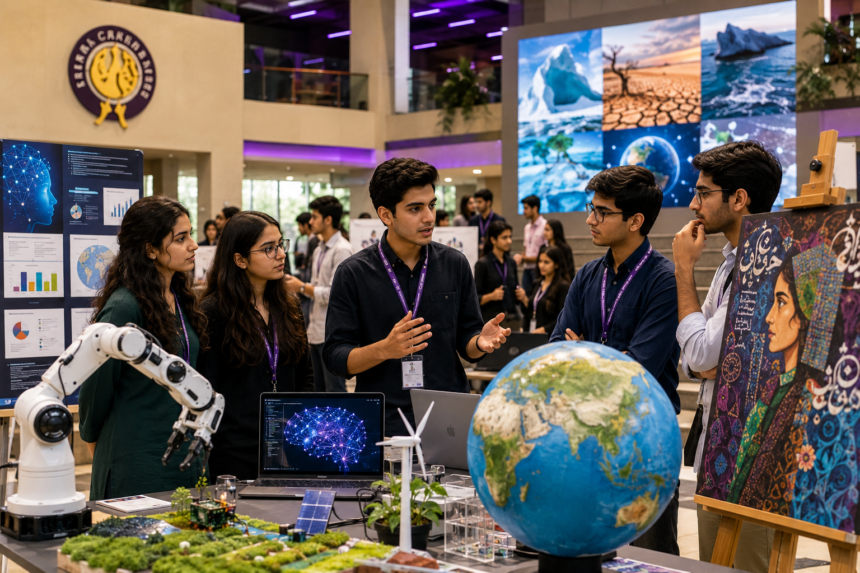
Habib University’s annual showcase turned the spotlight on undergraduate research this week, moving past academic theory to tackle real-world problems. Students presented projects spanning the volatile intersection of artificial intelligence, the escalating climate crisis, and the preservation of regional cultural identities. The event, which drew industry experts and local academics to the university’s Karachi campus, moved away from traditional poster presentations.
Instead, the focus remained on functional prototypes and data-driven policy recommendations. One project, centered on AI-driven energy optimization, caught the attention of local tech observers. The research team developed a model designed to predict power consumption spikes in industrial zones, aiming to reduce waste in a city currently grappling with chronic energy shortages. It’s a practical application of machine learning that moves the conversation beyond abstract algorithms and toward solving municipal grid instability.
Climate research also took center stage. A group of environmental science students presented findings on urban heat islands in Karachi, utilizing satellite imagery to map temperature variations across the city’s concrete-heavy neighborhoods. Their data suggests that targeted urban forestry could lower localized temperatures by as much as three degrees Celsius—a critical finding for a city facing increasingly lethal heatwaves. Beyond the technical data, the showcase carved out space for the humanities. Several projects examined how digital archiving can protect dying regional dialects and traditional craftsmanship.
One student’s documentation of Indus Valley weaving techniques, digitized through interactive media, offered a clear argument: cultural heritage doesn’t have to be lost to modernization it can be integrated into it.
“We aren’t just looking for grades here,” said one senior participant, who spent six months collecting field data for a project on water scarcity. “The goal was to see if the data we gathered actually holds up when you hold it against the reality of the city outside these gates.” The showcase closed with a panel of industry leaders who noted that while the research is promising, the true test lies in scalability.
For these students, the takeaway was simple: the bridge between a university lab and the actual streets of Karachi is shorter than it’s ever been. The university plans to assist several of the research teams in seeking industry partners to move their prototypes from the exhibition hall into pilot programs.