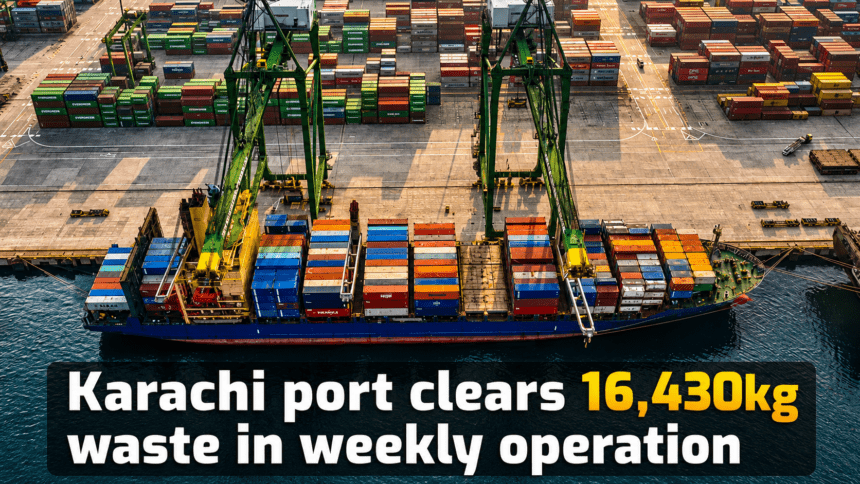
KARACHI — Karachi Port has cleared 16,430 kilograms of waste in a week-long cleanup operation, underscoring the scale of the pollution burden building up around the country’s busiest maritime gateway.
The weekly removal may sound like a routine maintenance figure on paper, but it lands in a much bigger story. Karachi Port Trust says the harbour is already under sustained environmental pressure from untreated municipal and industrial discharge, refuse from commercial activity around the waterfront, and waste linked to marine traffic. On its own official marine pollution page, KPT says the harbour is affected by roughly 400 million gallons a day of untreated industrial-cum-municipal waste entering the coastal environment.
That helps explain why even a single week’s waste recovery matters.
Karachi Port isn’t some marginal dockyard. It sits at a strategic point on Pakistan’s coastline and serves as one of the country’s central trade arteries, with KPT describing it as a regional gateway linked to Afghanistan, Central Asia and western China. The port’s own overview says it operates across major wharves and terminals spanning about 33 square kilometres, making uninterrupted operations and navigational cleanliness more than just a sanitation issue. It’s a trade issue too.
Recent KPT cargo data shows the port handled about 11.865 million tons of cargo between January 21 and April 21, 2026, alongside roughly 0.569 million TEUs in container traffic over the same period. In other words, this is a high-volume working port, and debris in berths, approach areas or harbour waters can quickly become a safety and efficiency problem.
The cleanup figure also fits a broader pattern seen over the past year. Earlier reporting from APP and other Pakistani outlets said Karachi’s ports were especially exposed after heavy rains, when stormwater drains carried sewage, solid waste, oil residue and untreated industrial effluent toward harbour waters and the open sea. A post-rain cleanup drive launched previously targeted berths, jetties and navigation channels specifically to keep pollutants from spreading and to protect marine life.
That wider concern has not gone away. Officials have also been tying port management more closely to green shipping, sustainability and marine conservation. Just days ago, APP reported that an EU delegation visiting KPT discussed green shipping, port modernization and sustainable connectivity with Karachi Port leadership. Separately, a 2025 maritime policy workshop highlighted marine pollution control as a national priority.
So, yes, 16,430 kilograms in a week is a cleanup statistic. But it’s also a warning sign.
For Karachi, where the sea is constantly asked to absorb the city’s overflow, waste collection at the port is doing double duty: keeping trade moving while trying to stop the harbour from becoming a dumping ground in slow motion.