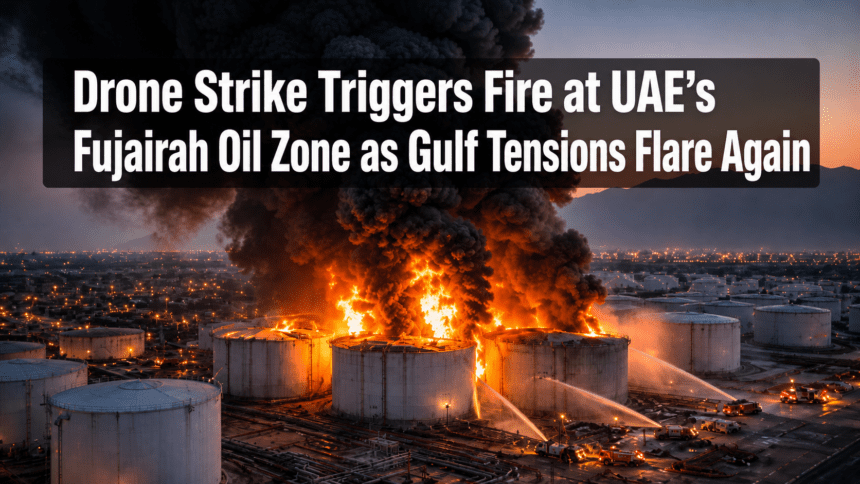
A drone strike set off a fire at the Fujairah Oil Industry Zone on Monday, May 4, according to authorities in the UAE emirate, in what appears to be one of the most serious incidents to hit the country’s energy infrastructure during the latest surge in Gulf tensions. Officials said civil defence teams were deployed immediately to contain the blaze, while wider regional security fears deepened amid fresh warnings over attacks linked to Iran and shipping routes near the Strait of Hormuz.
Authorities in Fujairah said emergency crews moved in without delay after the strike. Several reports said three Indian nationals suffered moderate injuries. The incident comes as the UAE says it has also faced renewed missile threats, adding to a climate of anxiety across the Gulf after what had been described as a fragile pause in hostilities.
The location matters. Fujairah is not just another industrial site on the UAE map; it is one of the region’s most strategically important oil storage and export hubs, sitting outside the Strait of Hormuz on the Gulf of Oman. That makes it especially sensitive at a moment when maritime traffic, tanker safety and energy flows are already under strain. Reporting from AP said the broader crisis has pushed the U.S. and its partners to focus on securing commercial shipping through the strait as military friction with Iran intensifies.
For the UAE, the attack sharpens a familiar fear: that regional confrontation is no longer confined to distant fronts or military installations, but is spilling into commercial and civilian-linked infrastructure with direct economic consequences. Oil facilities, ports and shipping lanes are obvious pressure points. Even when physical damage appears contained, the market signal is immediate — higher risk, higher insurance costs, and a fresh wave of uncertainty for energy traders watching every move in the Gulf. This is an inference based on the strategic role of Fujairah and current reporting on maritime disruption and rising market anxiety.
So far, official information remains limited. Fujairah authorities have focused on the emergency response and public safety messaging, urging people to rely on verified updates rather than rumor. There was no detailed public breakdown in the reporting I reviewed of the damage to storage or export infrastructure at the site itself. That gap is important, because in stories like this the first reports often establish the incident, but not the full operational fallout.
The timing is what gives this story its real weight. AP reported that the UAE condemned recent Iranian attacks, including the Fujairah strike, while the U.S. was simultaneously trying to safeguard shipping through the Strait of Hormuz. In that sense, the fire in Fujairah is more than a local emergency. It is another sign that the Gulf’s confrontation cycle may be widening again, with energy infrastructure increasingly exposed.