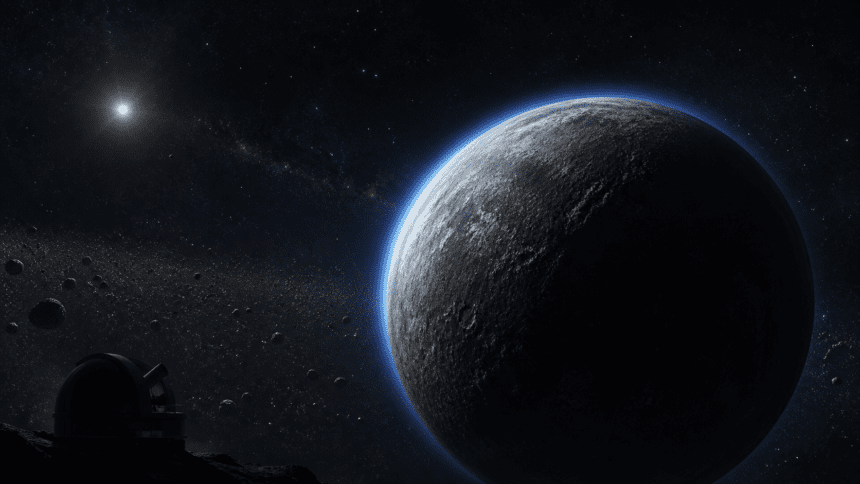
Astronomers say a small icy world beyond Pluto may have a very thin atmosphere, a finding that could reshape how scientists think about distant objects in the outer solar system. The object, formally known as (612533) 2002 XV93, lies in the Kuiper Belt and is considered a plutino, a body in orbital resonance with Neptune. Researchers say it may be the smallest known object with a global atmosphere held by gravity if the result is confirmed.
The possible atmosphere was detected through a stellar occultation, when the object passed in front of a distant star and briefly dimmed its light. Astronomers observed that event in 2024 using three telescopes in Japan, and the pattern of dimming suggested a thin atmospheric layer around the object rather than a bare icy surface alone.
What makes the result especially striking is the object’s size and location. The world is only about 300 miles (500 kilometers) across and sits farther from the Sun than Pluto, which until now was the only Kuiper Belt object known to have an observed atmosphere. Researchers say the suspected atmosphere is extraordinarily thin — roughly 5 million to 10 million times thinner than Earth’s and 50 to 100 times thinner than Pluto’s.
Scientists think the gas could be made of methane, nitrogen, or carbon monoxide, though that has not yet been pinned down. As for where it came from, there are a few possibilities: it may have been released by ice-volcanic activity, or it may be the aftermath of a comet impact that briefly supplied gas to the object.
Still, researchers are being careful. Outside experts say the finding is exciting but needs independent verification before it can be treated as settled. Future observations, potentially including work with the James Webb Space Telescope, could help confirm whether the atmosphere is real and whether it persists, fades, or changes over time.
If confirmed, the discovery would do more than add one more curiosity to the map of the solar system. It would suggest that even much smaller icy worlds in the Kuiper Belt may be able to hold atmospheres under the right conditions, which would widen scientists’ understanding of how active and complex the far outer solar system can be.