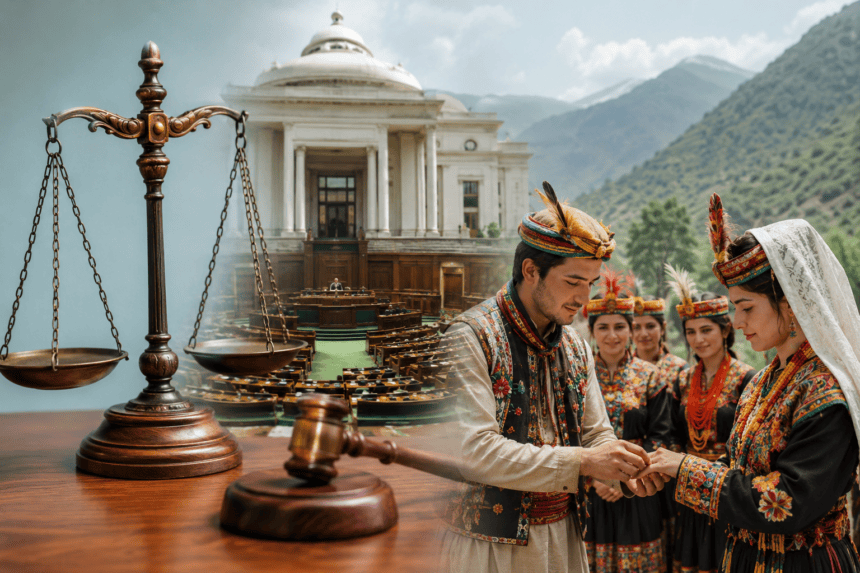
PESHAWAR — The Khyber Pakhtunkhwa Assembly passed the Kalash Marriage Bill 2026 on Tuesday, providing legal recognition to the unique customary marriage practices of the Kalash community. The legislation marks a significant shift in provincial policy, moving away from a one-size-fits-all civil code toward the protection of indigenous social structures.
For decades, the Kalash people—residing in the remote valleys of Chitral—have practiced marriage rituals governed by oral tradition rather than the statutes of the state. These customs, which allow for specific communal agreements and distinct separation protocols, often clashed with standard Pakistani family law.
“This isn’t just about paperwork,” said an official from the provincial law department. “It’s about recognizing that the Kalash have a distinct social identity that requires a legal framework compatible with their way of life.”
The new law mandates the registration of marriages through a community-led committee, ensuring that the Kalash’s traditional “Shara” (marriage) rituals are documented without forcing them to adopt external legal procedures. Critics of previous drafts had feared that bureaucratic oversight would dilute the cultural essence of the ceremonies. To counter this, the bill grants the local elders’ council primary authority over marriage disputes, limiting the role of state courts to instances where fundamental human rights are violated.
The legislation arrives as the community faces mounting pressure from modernization and shifting demographics. While the bill aims to preserve heritage, it also introduces mandatory age requirements for marriage, aligning local practice with national standards to curb child marriage—a move that saw initial pushback from some conservative factions within the valley.
The bill passed with a voice vote, facing minimal opposition. Lawmakers from Chitral argued that the move secures the Kalash’s status as a distinct cultural entity under the provincial constitution.
“We want our children to follow our ways, but we recognize the need for protection under the law,” a community representative noted after the session.
While the provincial government celebrates the bill as a win for minority rights, the true test lies in implementation. The government now faces the task of training local registrars in the valleys who can navigate both the complexities of state law and the nuances of Kalash custom. Without clear communication, the law risks becoming just another document in a Peshawar filing cabinet.
For now, the Kalash people have a legal shield for their traditions—a rarity in a region often dominated by rigid, standardized legal codes.