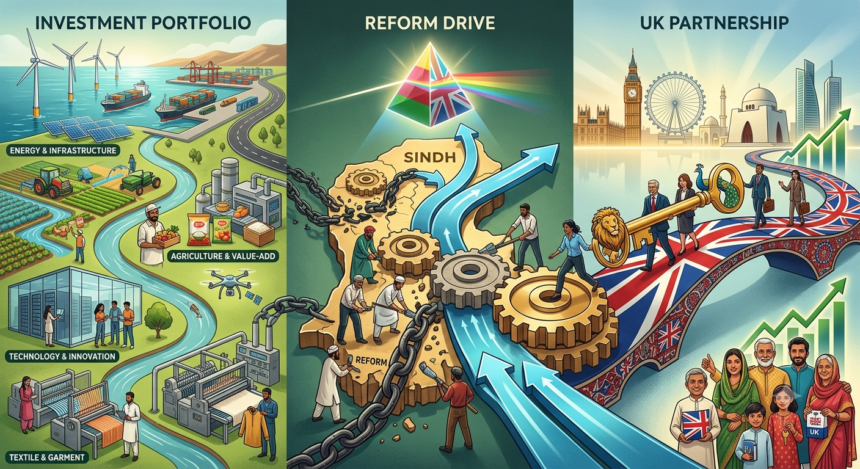
KARACHI — The Sindh government has launched a targeted push to lure British investors, banking on a series of regulatory overhauls aimed at easing the chronic friction of doing business in the province.
Provincial authorities are betting that streamlining property registration, automating tax filings, and clearing long-standing bureaucratic hurdles will shift the narrative for UK firms—many of whom have kept their distance due to opaque legal frameworks and complex land acquisition laws.
The strategy, spearheaded by the Sindh Board of Investment, focuses on three pillars: digitizing the land record system, establishing a single-window portal for industrial licensing, and formalizing a dispute resolution mechanism tailored for foreign entities.
“We aren’t just selling potential anymore; we’re fixing the plumbing,” said a senior official familiar with the policy rollout. “British firms value predictability above all else. If we can guarantee a clear title to land and a predictable tax timeline, the capital will follow.”
The move comes as the UK remains one of Pakistan’s largest trading partners, yet direct investment from London into Sindh has remained stagnant for years. British investors have historically cited the “cost of doing business” and the lack of a transparent grievance redressal system as the primary reasons for bypassing the region.
To bridge this gap, the provincial government has reached out to the British Deputy High Commission in Karachi, proposing a joint task force to monitor the implementation of these reforms. The goal is to provide a direct line of communication between foreign investors and the provincial cabinet, bypassing the layers of mid-level bureaucracy that traditionally stall projects.
Economists are cautious, however. While the reform agenda looks strong on paper, the real test lies in the execution. Sindh’s record on policy implementation is uneven, and investors are waiting to see if these changes survive the inevitable political shifts in the provincial assembly.
“The intent is clear, but the skepticism is rooted in years of broken promises,” said one financial analyst based in Karachi. “A single-window portal is a great start, but it only works if the people behind the desk actually allow it to function.”
The province is now preparing for a trade delegation from London scheduled for next month. Whether this reform drive translates into concrete infrastructure projects or remains another policy paper will depend on how quickly these digital systems go live—and, more importantly, how much political capital the government is willing to spend to keep them running.