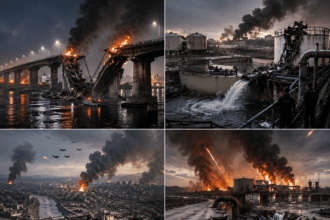
In a dramatic escalation that brings the United States directly into the ongoing Iran-Isr@el war, President Donald Trump announced on Saturday night that U.S. forces had carried out a coordinated airstrike on three major nuclear sites in Iran — including the heavily fortified underground facility at Fordo, the large-scale Natanz enrichment plant, and a uranium storage facility near Isfahan.
“All planes are now outside of Iran airspace,” Trump declared via social media, adding that “a full payload” of precision bombs had been dropped on Fordo. The operation marks the first confirmed U.S. military engagement in this regional war — a move likely to ripple across global diplomacy, energy markets, and military alliances.
Targeted Strikes on Iran’s Nuclear Infrastructure
The three nuclear facilities hit are considered critical to Iran’s alleged weapons program — though Tehran insists its enrichment efforts are for peaceful, civilian energy use.
-
Fordo, a hardened site dug deep into a mountain, had long been viewed as nearly impervious to attack — until now.
-
Natanz, Iran’s largest uranium enrichment plant, had already been damaged in an Isr@eli strike days earlier.
-
The Isfahan site reportedly contains near-weapons-grade uranium — enough to raise serious alarm within international watchdog circles.
Isr@el’s Foreign Minister Gideon Saar claimed the bombardment set Iran’s nuclear capabilities back “by at least two to three years,” but acknowledged Fordo remains operational.
⚔️ Retaliation and Resolve
Iranian President Masoud Pezeshkian, speaking to Mehr News Agency, vowed Iran would never halt its nuclear program completely, defying U.S. demands. “We are ready to talk and cooperate,” he said, “but under no circumstances will we reduce our nuclear activities to zero.”
He further warned of continued military retaliation against Isr@el.
Day of Airstrikes and Assassinations
Saturday saw waves of airstrikes and ballistic missile exchanges:
-
Isr@el launched heavy bombardments on Iranian missile sites, nuclear facilities, and weapons depots.
-
Iran responded by firing ballistic missiles and sending swarms of drones toward Isr@el’s military bases and strategic infrastructure.
-
Three senior commanders of the Islamic Revolutionary Guard Corps (IRGC) — Mohammed Said Izadi, Behnam Shahriyari, and Aminpour Joudaki — were reportedly killed in Isr@eli strikes. Iran has yet to confirm the deaths.
Americans Evacuated
The U.S. State Department has begun emergency evacuations of American citizens from Isr@el and the West Bank. Ambassador Mike Huckabee urged U.S. nationals to submit evacuation requests, noting that departures may occur via cruise ships, commercial flights, chartered aircraft, or government-operated missions.
What Comes Next?
With the U.S. now openly bombing Iranian targets, the possibility of an expanded regional war looms larger than ever. Analysts warn that if Trump orders continued strikes — particularly on fortified uranium facilities — the Middle East could be pushed into an unprecedented and dangerous phase of conflict.
Expect heightened alerts in the Strait of Hormuz, more proxy retaliation across Iraq, Syria, and Lebanon, and global calls for de-escalation.