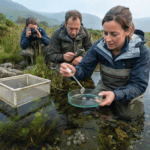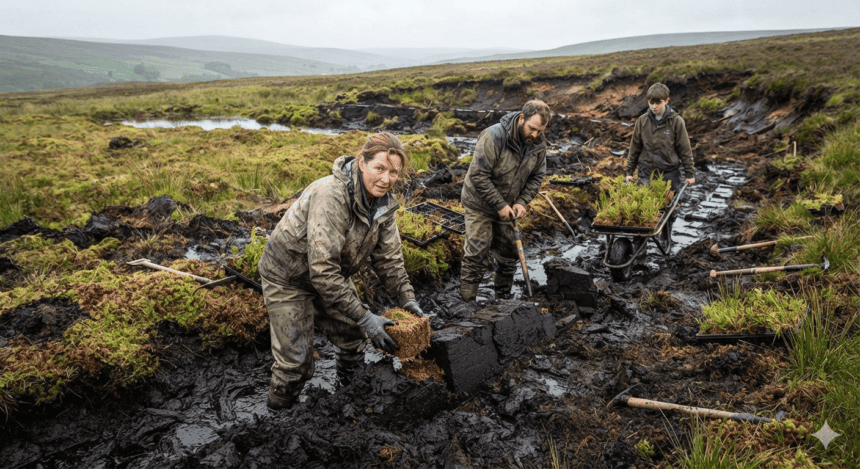
Peatlands are losing their battle against time, but a handful of conservationists are fighting back with shovels and heavy machinery. In the remote stretches of the British Isles and Northern Europe, the “muddy work” of restoring ancient bogs has moved from niche ecological theory to a frantic, last-ditch effort to stop these carbon-rich landscapes from turning into tinderboxes.
For decades, these bogs were drained for agriculture or forestry. The result was a dried-out, cracked landscape that stopped capturing carbon and started releasing it. Now, teams are working to plug the drainage ditches, slowing the flow of water and forcing the land to re-wet. It’s not elegant work. It involves dragging heavy plastic dams through knee-deep muck and waiting for the sphagnum moss to reclaim the scars left by industrial-scale drainage.
The stakes go beyond just local biodiversity. Peatlands cover only three percent of the earth’s land surface but store twice as much carbon as all the world’s forests combined. When a bog dries out, that stored carbon oxidizes and leaks into the atmosphere. Restoring them isn’t just about saving rare orchids or specific butterfly populations; it’s a fundamental piece of the global climate puzzle that has been ignored for far too long.
“We’re essentially trying to reverse a century of damage in a single season,” says Sarah Jenkins, an ecologist overseeing restoration projects in the Scottish Highlands. She spends her days navigating terrain that tries to swallow her boots, checking the placement of timber dams. “You can’t just flip a switch. You build the dam, you wait for the rain, and you hope the moss catches on. If it doesn’t, the carbon keeps leaking.”
The process is agonizingly slow. Unlike planting a forest, where results are visible within a few years, bog restoration is measured in decades. A healthy bog grows at a rate of roughly one millimeter per year. It takes thousands of years to build the deep, dark peat layers that define these ecosystems.
Critics argue the cost of restoration is prohibitive compared to simply planting trees. But trees are prone to disease and wildfire; a healthy, waterlogged bog is naturally fire-resistant. As temperatures climb and the risk of wildfire increases in northern latitudes, these wet, muddy sponges are becoming the most effective insurance policy against a warming climate.
For now, the work continues in the mud. It is a quiet, unglamorous race against time, conducted far from the high-level climate summits where the policies are written. The success of these projects won’t be measured in press releases, but in the slow, silent return of the water to the land.