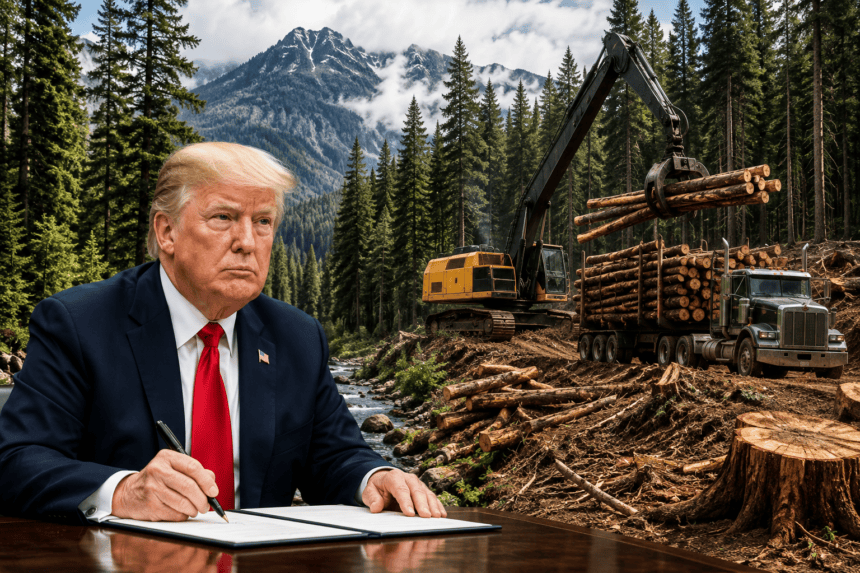
The Trump administration is finalizing rules to open millions of acres of protected national forest land to commercial logging. The shift, expected to be formalized in the coming weeks, would bypass long-standing conservation protections to prioritize timber production and forest management strategies favored by industry lobbyists.
The move centers on the Tongass National Forest in Alaska and various “roadless” areas across the American West. Officials within the Department of Agriculture argue the plan reduces wildfire risks by thinning overgrown timber stands. Critics, however, see a calculated push to monetize public lands at the expense of biodiversity and carbon sequestration.
“We aren’t just talking about dead wood,” said Sarah Jenkins, a forest ecologist who has tracked federal land policy for two decades. “We’re talking about old-growth ecosystems that take centuries to recover. Once those roads go in, the character of these forests changes permanently.”
The economic argument for the expansion rests on the promise of revitalizing rural timber economies. For decades, these communities have struggled as the industry shifted away from federal land dependence. Yet, economists point to a glut in the current timber market, suggesting that increased supply from national forests may do little to boost local wages while significantly lowering the value of private timber holdings.
Environmental groups are already preparing legal challenges. The core of their argument hinges on the National Environmental Policy Act (NEPA). They contend that the administration is fast-tracking these projects without the rigorous, multi-year impact studies required for land-use changes of this scale.
Inside the administration, the directive is viewed as a win for “active management.” Proponents argue that federal forests have become fire traps due to decades of fire suppression and limited harvesting. They claim that by inviting private firms to clear-cut underbrush and harvest mature timber, the government can shift the financial burden of forest maintenance onto the private sector.
The policy change arrives as the U.S. Forest Service faces its tightest budget in years. With wildfire suppression costs consuming more than half of the agency’s annual appropriation, officials are desperate for alternative funding models.
Whether this shift serves as a legitimate wildfire mitigation strategy or a giveaway to the logging industry remains the central point of contention. As the administration prepares to sign the final orders, the battle is moving from the halls of the Department of Agriculture to the federal courts, where environmental litigators are ready to force a stay on any immediate harvesting.