Journalists, policy experts, and representatives from the development sector have described maintaining a balance between population and resources as essential for Pakistan’s economic stability, human development, and equitable distribution of resources. They emphasized the need to increase investment in family planning, health, and education sectors and ensure the effective utilization of allocated funds.
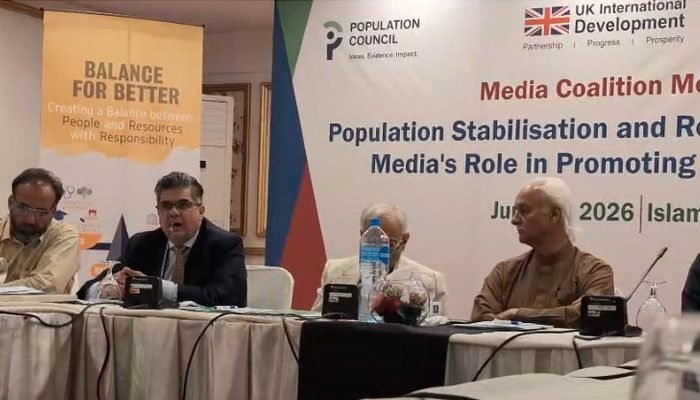
These views were expressed during a Media Coalition Meeting held in Islamabad in collaboration with Population Council Pakistan and UNFPA, attended by journalists, policy experts, and representatives of development organizations from across the country.
Addressing the meeting, Population Council Pakistan Country Director Dr. Ali Mir said that spending on health and education is, in fact, an investment in the country’s future.
He stressed the need to further strengthen the delivery system of family planning services, particularly the Lady Health Worker Program, adding that adequate spacing between births is extremely important for the health of both mother and child and is also consistent with Islamic teachings.
Referring to the “Waqfa Campaign,” Dr. Ali Mir said that the media has played an effective role in promoting family planning and the concept of healthy families among the public.
He also stated that Geo News and Jang, through the Waqfa Campaign carried out in collaboration with Population Council Pakistan, highlighted this important national issue at the public level, encouraging positive discussion on family planning, maternal and child health, and population related challenges.
Population Council Communications Manager Ikram ul Ahad, in his presentation, stated that Pakistan’s population is growing at an annual rate of approximately 2.5 percent, while government spending on population and family planning remains lower than that of several countries in the region. He said that achieving national targets would require stronger evidence-based policymaking and enhanced accountability mechanisms within relevant institutions.
Speaking at the meeting, Senior Economic Adviser Ammar Ali Qureshi said that balancing population and resources is not merely a social issue but an economic necessity. According to him, rapid population growth, limited resources, and economic challenges are affecting the pace of national development.
He added that women’s education, economic empowerment, and participation in the labor force are of key importance for sustainable development and reducing birth rates.
Media representatives participating in the program held detailed discussions on challenges facing the health, education, and population sectors, including limited resources and issues related to service delivery.
Participants emphasized that the media can play a vital role in creating public awareness, providing accurate information, encouraging positive behavioral change, and monitoring the implementation of government commitments and policies.
The participants stated that addressing Pakistan’s population challenge requires not only government measures but also effective cooperation among the media, civil society, development partners, and policymakers.
At the conclusion of the meeting, participants agreed that population balance is a national priority, and achieving it requires political commitment, adequate financial resources, effective policy implementation, and continuous public awareness.